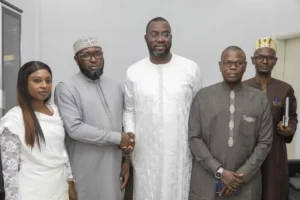


Lagos Attorney General warns of potential crisis if central gaming bill is not withdrawn


Lawal Pedro described the legislation as a clear breach of the constitution and the Supreme Court’s November 2024 judgment.
Nigeria.- Lagos State has raised objections to the National Assembly’s efforts to pass the Central Gaming Bill, arguing that it oversteps federal authority and ignores a key Supreme Court ruling. The bill, which has cleared the House of Representatives and is now under Senate review, seeks to repeal the National Lottery Act of 2005 and its 2017 amendment, establishing federal oversight for online and remote gaming nationwide.
At a press briefing in Lagos on October 15, 2025, Lawal Pedro, the state’s Attorney General and Commissioner for Justice, described the legislation as a clear breach of the constitution and the Supreme Court’s November 2024 judgment.
The judgment determined that lotteries, betting and gaming fall under state control, except in the Federal Capital Territory (FCT), and issued a perpetual injunction against federal enforcement of similar laws in states.
Pedro explained that the bill’s focus on cross-border online gaming does not justify federal intervention. He said: “Online does not mean federal. If online activity automatically becomes federal, then the United Nations should regulate it globally. The use of technology does not alter the legal character of gaming, which remains a state matter whether done physically or virtually.”
The objection comes as Nigeria’s online gaming sector continues to expand, with projections estimating it could generate up to $2.59bn (€2.38bn) in revenue by the end of 2025. State governments, including Lagos, have moved to regulate this growth locally. In September 2025, Lagos Governor Babajide Sanwo-Olu signed a bill updating the state’s lottery and gaming laws to cover online services, aiming to ensure fair practices and revenue collection within its borders.
Pedro warned that passing the bill could lead to broader conflicts, including forcing gaming operations into states where local laws or cultural norms restrict such activities. He added: “If the bill becomes law, it will allow operators to set up gaming businesses across all states, including those where gambling is forbidden by religion or tradition. This could create social tension and conflict.”
The Federation of State Gaming Regulators of Nigeria (FSGRN) has echoed these concerns, urging the National Assembly to withdraw the bill in a statement released in October 2025. The group called it “constitutional overreach” that undermines state rights and could disrupt established regulatory frameworks.
The Attorney General stressed that Lagos, along with the other states from the 2024 lawsuit, stands ready to oppose any actions eroding state autonomy. He asserted: “This is not about Lagos State alone. It is about Nigeria, about protecting the integrity of the Supreme Court and preserving the federal structure as guaranteed by the constitution.”
He called on lawmakers to uphold the rule of law and withdraw the bill to avoid a potential crisis, saying: “The rule of law is the soul of democracy. Our democracy will remain strong only if we respect the Constitution and the finality of Supreme Court decisions.”
The Senate has not yet responded publicly to the objections. If enacted, the bill would establish a centralised body to regulate and oversee gaming activities, including in the FCT, with the goal of increasing federal revenue.