


Khalid Ali, IBIA: “Higher alert volumes in mature markets often indicate stronger detection capability rather than higher inherent risk”
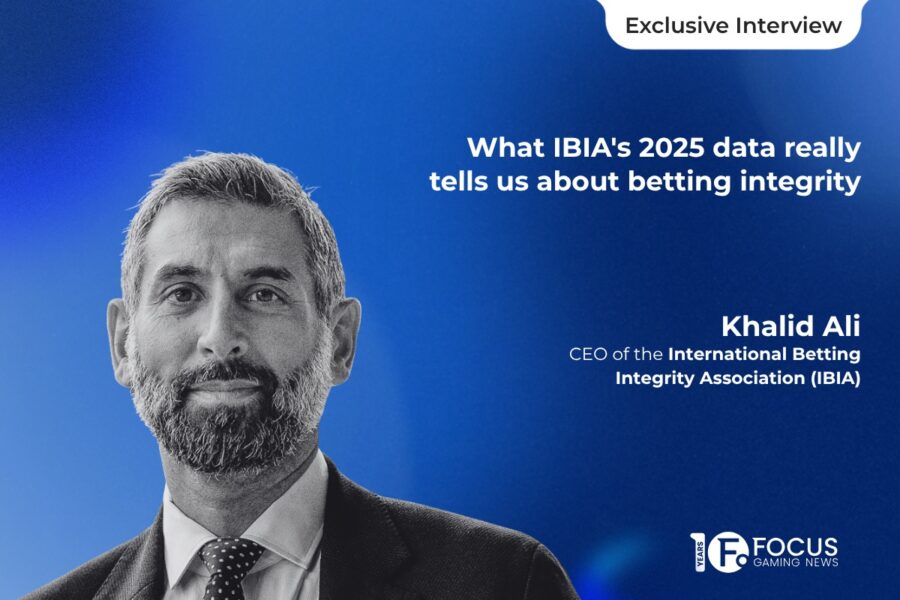

Focus Gaming News spoke with Khalid Ali, CEO of the International Betting Integrity Association, about the expansion of monitoring reach in regulated markets.
Exclusive interview.- As global betting markets continue to expand, the integrity of sport remains under increasing scrutiny, with data and monitoring playing a central role in identifying and preventing corruption. While headline figures often suggest rising risks, the reality is more complex, shaped by the growth of regulated markets and the sophistication of detection systems.
In this context, Focus Gaming News spoke with Khalid Ali, CEO of the International Betting Integrity Association (IBIA), following the publication of the association’s latest integrity report. In this exclusive interview, Ali unpacks the meaning behind rising alert volumes, examines patterns across key sports and regions, and explains why regulated markets remain a critical line of defence in the fight against match-fixing.
IBIA reported 300 suspicious betting alerts in 2025, a 29 per cent rise on 2024. How much of that increase reflects greater integrity risks rather than expanded monitoring, and what should regulators and sports bodies take from that figure?
The increase to 300 alerts in 2025 should not be read as a direct indication of a rising integrity risk. IBIA’s position is that alert volumes are shaped by several factors, including the expansion of regulated betting markets and associated improvements in monitoring reach and effectiveness. In that sense, a higher alert count often reflects stronger visibility and better detection capability within regulated markets rather than a like-for-like increase in corruption itself.
The key point is that alerts are a product of oversight. They show that regulated operators are identifying, sharing and escalating concerns, which is precisely how an effective integrity system should function.
For regulators and sports bodies, the message is twofold. First, suspicious betting reporting should be a standard regulatory requirement supported by robust national and international information-sharing arrangements. Second, alerts should be treated as actionable intelligence rather than headline figures of proven corruption; they are the start of an investigatory process. IBIA’s account-level monitoring model is designed to support investigations and enforcement, as evidenced by its contribution to 54 proven corrupted matches and 24 sanction outcomes in 2025.
“The increase to 300 alerts in 2025 should not be read as a direct indication of a rising integrity risk.”
Khalid Ali, CEO of the IBIA.
Football and tennis once again generated the majority of suspicious betting activity in 2025. Over the last five years, what consistent patterns have you seen in terms of competition level, regions and bet types in these two sports, and have you noticed any shift in where or how attempts to manipulate matches are taking place?
Over the past five years, football and tennis have consistently generated the largest share of IBIA alerts, which reflects their global popularity and the volume of betting activity they attract.
Regionally, football alerts in 2025 were concentrated in Europe and South America, while tennis alerts were more dispersed across Europe, Asia and North America. This does not point to a single geography of concern but rather to a shifting landscape influenced by where competitions take place, where betting markets are active and where monitoring visibility is strongest.
In terms of betting behaviour, suspicious activity often clusters around markets or phases of play where volumes or account activity deviate materially from expectations. What has evolved is not the core logic of manipulation but the environment in which it occurs. As betting markets have become more global and faster-moving, attempts can be distributed across jurisdictions and operators with greater speed. That reinforces the need for coordinated monitoring and international information sharing.
Given that football and tennis repeatedly top your alerts, how would you assess the performance of regulated betting markets compared with less regulated or offshore markets when it comes to preventing and detecting corruption in these sports?
IBIA’s view is clear: regulated betting markets are part of the solution, while offshore and less regulated markets remain the primary vulnerability.
Alerts in football and tennis should not be interpreted as a failure of regulated markets. On the contrary, they demonstrate that licensed and well-regulated operators are actively monitoring activity, identifying suspicious patterns and reporting them. Unregulated offshore markets, by comparison, typically lack the same level of transparency, customer due diligence and reporting obligations, which makes them more attractive to those seeking to avoid detection.
This distinction is critical. IBIA’s model is based on account-level monitoring supported by KYC and transaction data, providing a far stronger evidential foundation than systems that rely solely on odd movements. That enables regulated markets not only to detect anomalies but also to support investigations with meaningful intelligence.
From a policy perspective, the more betting is channelled into well-regulated markets, the stronger the overall integrity framework becomes. Conversely, restrictive or poorly designed regulation risks pushing activity into unregulated offshore environments where oversight is weaker.
Europe accounted for 35 per cent of IBIA’s alerts in 2025, but you also highlight growing activity in both North and South America. How do differences in regulatory models, market maturity and the rapid growth of online betting help explain those regional patterns, and in which regions do you see the greatest integrity vulnerabilities?
Europe accounted for 35 per cent of alerts in 2025, with North America at 16 per cent and South America at 15 per cent. These patterns largely reflect where regulated markets are most developed and where monitoring frameworks are most active.
Higher alert volumes in mature markets often indicate stronger detection capability rather than higher inherent risk. In newer or rapidly expanding markets, particularly in parts of Africa and the Americas, the growth of online betting can outpace the development of regulatory and integrity frameworks if those are not implemented in parallel.
North America has made significant progress, with regulated markets expanding and integrity monitoring becoming embedded in regulatory requirements. South America is evolving quickly, but levels of regulatory maturity and enforcement capacity still vary across jurisdictions. Europe remains diverse, with both highly mature systems and areas where governance structures are less developed.
Vulnerability is not defined purely by geography but by the strength of regulation, the effectiveness of reporting systems and the level of cooperation between stakeholders. The greatest risks arise where betting activity is pushed into unregulated channels or where oversight frameworks are weak or ineffective.
“Vulnerability is not defined purely by geography but by the strength of regulation, the effectiveness of reporting systems and the level of cooperation between stakeholders.”
Khalid Ali, CEO of the IBIA.
eSports, table tennis and basketball also saw significant alerts; how is IBIA adapting its monitoring for emerging or lower-tier sports? What are the main challenges compared with monitoring top-tier football or tennis?
IBIA applies the same core monitoring principles across all sports while adapting its analysis to the specific risk profile of each. In 2025, eSports and table tennis each generated 34 alerts, while basketball generated 27, underlining the importance of maintaining coverage beyond traditional top-tier sports. Indeed, our monitoring process covers any sport our members offer, which number over 80 different sports generating over 1.5 million sporting events each year.
Top-tier football and tennis generally benefit from strong governance structures, more established integrity systems and greater transparency. Whereas emerging and lower-tier sports often have less developed governance and integrity frameworks, which corrupters may seek to exploit…
These variations are factored into IBIA’s approach and our members’ risk assessment monitoring and reporting protocols, generating actionable operator intelligence. IBIA’s account-level monitoring is particularly valuable in lower-tier environments because it allows suspicious behaviour to be analysed through customer activity, linked accounts and transaction patterns rather than relying solely on broader market signals. Alongside detection, IBIA continues to emphasise prevention through education and closer cooperation with sports bodies and regulators.
Turning to the Africa Focus: With 117 alerts from 2021-2025 and GGR projected to hit US$19.4bn by 2030, what specific collaborations is IBIA pursuing there?
Africa is a priority region for IBIA, not only because of its rapid market growth but also because it represents a critical opportunity to embed strong regulation and integrity frameworks at an early stage of market development. A key recent development is IBIA’s strategic partnership with the African iGaming Alliance (AIA), which establishes a structured framework for collaboration across the continent. Under this agreement, IBIA acts as the integrity partner while AIA supports policy and regulatory engagement. The partnership facilitates the exchange of intelligence, joint policy initiatives and coordinated efforts to strengthen betting integrity standards across African markets.
Beyond formal partnerships, IBIA is actively engaging with regulators and stakeholders through platforms such as the Gaming Regulators Africa Forum (GRAF) and major industry events like SiGMA Africa. These engagements are focused on promoting practical integrity measures, including data monitoring, structured information-sharing and coordinated enforcement approaches across jurisdictions.
More broadly, IBIA’s work in Africa aligns with its wider Mission 2030 strategy, which centres on three pillars: strengthening monitoring capabilities, expanding collaboration and advancing prevention through better regulation and education. In practical terms, that means supporting regulators in embedding suspicious betting reporting requirements, enabling access to IBIA’s Global Monitoring and Alert Platform (Global MAP) and promoting education initiatives for athletes and stakeholders.
By Focus Gaming News Editorial Team