


ISPA says South Africa should only block illegal offshore gambling websites under a clear legislative framework
The country’s official Internet Industry Representative Body says any move to block illegal offshore gambling websites should be introduced through legislation, judicial oversight and judicial review as regulators step up enforcement efforts.
South Africa.- South Africa’s Internet Service Providers’ Association (ISPA), the country’s official Internet Industry Representative Body (IRB), says any move to block illegal offshore gambling websites requires a clear legislative framework, judicial oversight and judicial review after the National Gambling Board (NGB) proposed internet blocking as part of its crackdown on unlicensed operators.
In a position paper published on July 2, ISPA said the NGB’s request for the Department of Communications and Digital Technologies to implement internet blocking should be supported by a clear legislative framework that protects constitutional rights while addressing illegal offshore gambling targeting South African consumers.
Although ISPA said it is not opposed to internet blocking in principle and accepts that internet service providers may be required to restrict access to certain forms of illegal online content, it argued that any such measures should be introduced only through legislation that prevents unintended consequences.
Sasha Booth-Beharilal, ISPA chair, said: “ISPA’s position is that any disruption of internet services to South Africans should be done only as part of a clear legislative framework that balances the right to communicate against the potential harm of problematic content.”
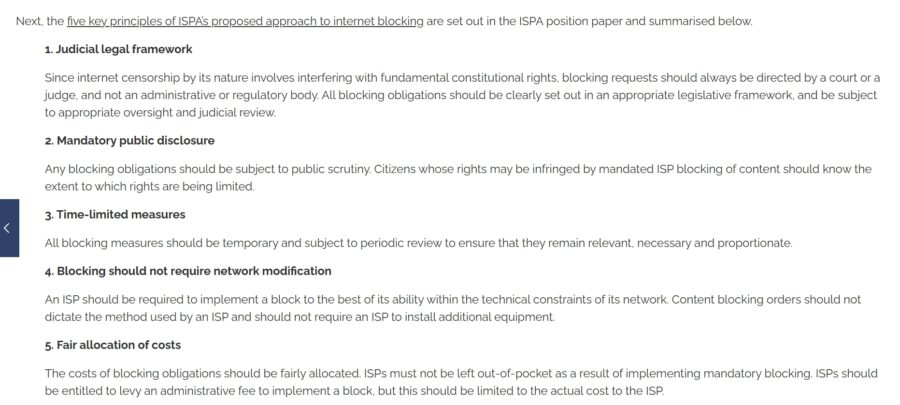
Rather than opposing website blocking outright, ISPA proposed five principles that it believes should underpin any future framework. These include requiring court-approved blocking orders, publicly disclosed blocking requirements, regular reviews of blocking measures, ensuring regulators do not prescribe the technical methods used by internet service providers, and fairly allocating implementation costs.
ISPA said the three most common website-blocking techniques-domain name system (DNS) blocking, IP address blocking, and deep packet inspection-each have technical limitations, ranging from being easy to bypass to inadvertently blocking legitimate websites or raising privacy and constitutional concerns.
Booth-Beharilal said: “Regulators are often quick to conclude that requiring ISPs to disrupt the services they provide to their customers will be a silver bullet to solve their problems. International experiences indicate otherwise.
“While there are some, limited circumstances where there may be a need for specific content to be blocked, such steps often have unintended consequences.”
Growing illegal gambling concerns
ISPA’s position comes amid growing concern over online gambling in South Africa. Researchers told a Stellenbosch University symposium in June that South Africans wager around R1.5trn (US$92.3bn) annually. Higher Education and Training Deputy Minister Nomusa Dube-Ncube warned that gambling platforms were increasingly targeting young people, while acting NGB head Lungile Dukwana said the regulator was working with the National Student Financial Aid Scheme (NSFAS) to help protect students and safeguard public funds.
The South African Bookmakers Association (SABA) has meanwhile backed the NGB’s enforcement drive while agreeing that any website-blocking measures should be supported by legislation, regulatory oversight and constitutional safeguards.
SABA argues that South Africa’s biggest challenge is not a lack of laws prohibiting illegal online gambling, but legislation that enables effective enforcement against offshore operators.
Sean Coleman, SABA CEO, said: “We fully support the NGB’s heightened enforcement actions that include a technological component, High Court forfeiture operations, and the coordinated legislative push to eradicate these illicit networks.”
According to a 2024 Yield Sec report commissioned by SABA, illegal offshore operators account for approximately 62 per cent of South Africa’s online gambling activity, diverting more than R50bn (US$3.1bn) in gross gambling revenue offshore each year. The report also estimated that around 16 million South Africans had used unlicensed gambling platforms during the previous year.