


Corner Handicap meaning: How it works and how to use it when betting


Contents:
- How corner handicap works – The basic rules
- Positive vs. Negative corner handicaps
- How the final corner count affects your bet
- Over/Under corner betting: The other side of the coin
- Corner handicap vs. Over/Under corners: key differences
- Strategies for betting on corner handicap lines
- When to use negative corner handicap (-1.5, -2.5, etc.)
- When to use positive corner handicap (+1.5, +2.5, etc.)
- Use stats: average corners per match and corner maps
- Mastering corner handicap betting
- FAQs
- Are corner bets available for both halves?
- Can I use corner handicap in live betting?
- What happens if teams have the same number of corners on a whole number handicap?
Let’s talk about corner handicap betting. Honestly, when you first start looking beyond the usual Match Winner or Over/Under Goals, this is where things get really strategic. It’s a popular market that completely ignores the final score and instead focuses purely on the number of corners each team racks up.
Why does it exist? Simple. Bookmakers use the handicap to level the playing field. If, say, Liverpool is playing a newly promoted side, everyone knows Liverpool is going to dominate. So, to make the corner count interesting, the bookie slaps a “handicap” on the stronger team. For instance, if Liverpool gets a -2.5 corner handicap, they have to win at least three more corners than the opponent for your bet to cash out. It’s a clever way to find value even in the most one-sided games.
How corner handicap works – The basic rules
Corner handicap betting works exactly like goal handicap betting, but we’re swapping goals for, well, corners. One team essentially starts the game with a virtual advantage or disadvantage to their corner count. The final outcome is only determined after that handicap is applied to the final tally.
Positive vs. Negative corner handicaps
You need to know your signs!
- Positive Handicap (+): This gives the team an advantage. For example, if you bet on Team B +1.5 corners, that team can actually lose the final corner count by one (say, 5-4) and your bet still wins! They get the ‘head start.’
- Negative Handicap (-): This means the team starts with a deficit. Betting on Team A -2.5 corners means they must absolutely smash their opponent by three or more corners for you to win.
How the final corner count affects your bet
Let’s quickly run through a scenario to make it crystal clear. Say you put money on Team A -1.5 corners:
- If Team A wins 6 corners and Team B wins 3: We apply the handicap: 6 minus 1.5 equals 4.5 vs 3. Your bet wins. Easy money.
- If Team A wins 5 corners and Team B wins 4: The adjusted score is 5 minus 1.5, which is 3.5 vs 4. Your bet loses. Even though Team A won the corner count, they didn’t beat the handicap.
Over/Under corner betting: The other side of the coin
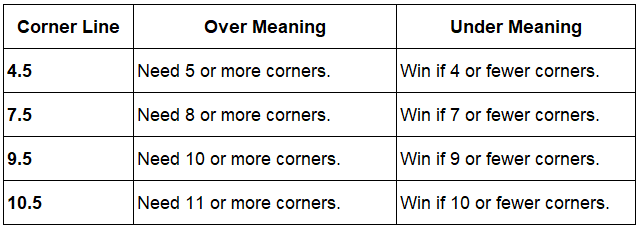
Now, you don’t always have to deal with handicaps. Besides, many punters prefer the Over/Under corner markets, which are about predicting the total number of corners in the entire match, regardless of who wins them. The bookmaker sets a line (usually ending in .5 to eliminate a push), and you decide if the total will be Over or Under that number.
This is pretty intuitive, but just to be sure:
See also: What is Handicap in Betting and how does It work?
Corner handicap vs. Over/Under corners: key differences
It’s important to know when to use which market. The truth is, they tell you different things about the game:
- Corner Handicap focuses on dominance and control. It’s all about the difference in the corner count between the two teams.
- Over/Under Corners focuses on match tempo and attacking intent. It’s about the total quantity of corners, regardless of which team gets them.
So, if you know one team is an absolute machine at earning set pieces, the Handicap is your best friend. But if you’re just predicting a fast-paced, back-and-forth game with lots of crosses, Over/Under is probably the better call.
Strategies for betting on corner handicap lines
Corner betting can be very profitable, but you can’t just guess. Here are a few expert pointers for mastering the handicap lines.
When to use negative corner handicap (-1.5, -2.5, etc.)
You want to use the negative handicap when you’re absolutely confident one team will dominate.
- Home Dominance: This works best when a strong attacking team is playing at home against an underdog. That home crowd factor and pitch familiarity make a difference.
- Style of Play: Does the team push hard on the wings? Do they cross the ball frequently instead of trying central passes? These teams tend to win masses of corners.
- Stats Backing: They must have a history of winning significantly more corners than their opponent—check their corner maps and recent averages.
When to use positive corner handicap (+1.5, +2.5, etc.)
This is where you find real value in the underdogs!
- Defensive Counters: Use this when the underdog plays a deeply defensive, counter-attacking style. They might concede possession all game, but those desperate clearances and quick breaks can still earn them a decent number of corners.
- Cup or Rivalry Games: These matchups are often closer than expected. Backing the underdog with a +2.5 handicap is usually a very safe bet in tight contests.
- Spotting Overreaction: If the bookie has given the favourite too harsh a negative handicap, you can jump in on the generous positive handicap for the underdog.
See also: Asian Handicap betting: How It works and why It matters
Use stats: average corners per match and corner maps
As you know, betting without data is just guessing. You need to look beyond the general win/loss record:
- Averages: Check the average corners won and conceded by both teams over their last 5–10 games. Look for clear trends.
- Heatmaps: This is the pro-level stuff. Where are the shots coming from? If a team takes most shots from wide areas near the goal, they are highly likely to generate corners.
Mastering corner handicap betting
Mastering corner handicap betting adds a fantastic new layer of strategy to your sports betting. It’s ideal for punters who follow team styles, stats, and game plans closely—not just the headlines.
Whether you’re backing the big teams to completely overwhelm the opposition or spotting sneaky value in a defensive underdog, corner markets offer more diverse opportunities than simply betting on goals or match winners. The best part is that they let you bet on how a team plays — not just whether they win. Track the trends, use your data, and remember: discipline and research are, as always, your keys to success.
FAQs
Are corner bets available for both halves?
Absolutely. Many good sportsbooks will offer markets for first-half, second-half, and full-match corner totals and handicaps. Betting on the first half can be a great way to predict a fast start!
Can I use corner handicap in live betting?
You bet! Live corner betting can be hugely profitable. If you’re watching the game and see one team relentlessly attacking and missing, getting denied by the keeper, or hitting the side netting, you know corners are coming, and you can jump on a live negative handicap for that dominant team.
What happens if teams have the same number of corners on a whole number handicap?
If you bet on a handicap that has a half-unit (like -1.5 or +0.5), the result is always clear—you either win or lose. However, if you bet on a whole number handicap (like Team A -1) and the final score is 5-4, the adjusted score is 4-4. In this case, it usually results in a push (or void), and your stake is returned, depending on the bookmaker’s rules.
See also: Over/Under Betting: What It means, how It works, and a full guide to goal lines
By Focus Gaming News Editorial Team