


5 Leaders – 1 Question: Brazil’s illegal gambling market and the tools to move players to licensed platforms

Five key figures in the igaming industry share their views on the regulatory tools that Brazil needs in order to encourage players to move from illegal gambling to licensed environments.
Special report.- Although the regulated market for sports betting and online gaming in Brazil has been in operation for a year and a half, the shadow of illegal gambling has not entirely disappeared, despite ongoing government controls and regulations.
Recent studies supported by the Brazilian Institute for Responsible Gaming (IBJR) estimate that between 41 and 51 per cent of Brazil’s online betting market remains illegal, with billions of reais in wagers and tax revenue flowing outside the regulated channel.
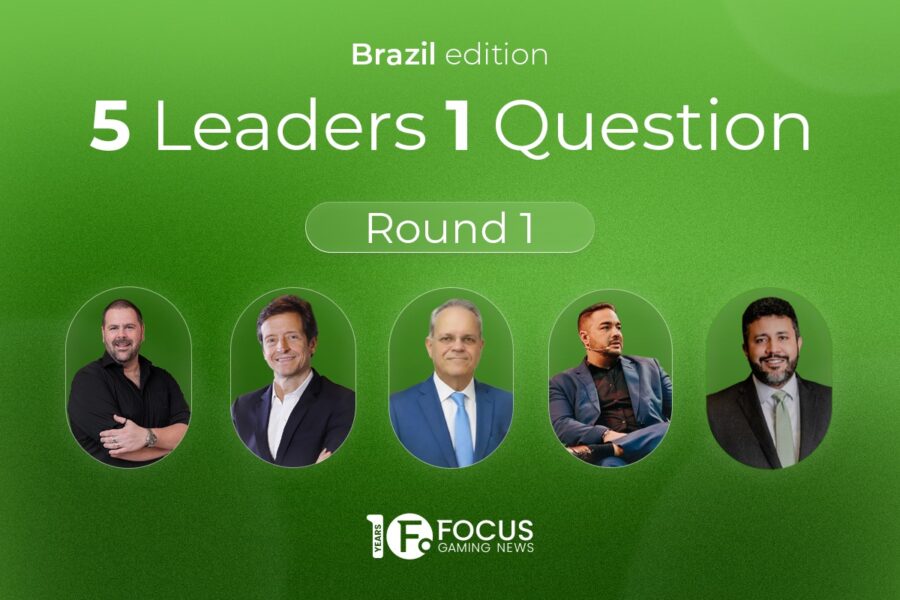
For this new edition of “5 Leaders – 1 Question”, Focus Gaming News asked five industry figures: Which regulatory tool would be the most effective in channelling players to licensed platforms?
The participants are Leonardo Baptista, CEO and co-founder at Pay4Fun; André Gelfi, director, board member and co-founder of the IBJR; Amilton Noble, CEO at Hebara; Thomas Carvalhaes, igaming executive; and Luiz Felipe Maia, founding partner at Maia Yoshiyasu Advogados.
Payment controls as the frontline tool
For Leonardo Baptista, CEO and co-founder at Pay4Fun, the most powerful short-term weapon against illegal betting is clear: cutting off access to the financial system.
“In Brazil, irregular operators depend directly on access to the financial system, especially Pix, to function,” he says. “When there is stricter supervision, with account closures, disruption of financial flows and the imposition of meaningful fines, the business model of these platforms stops being viable.”
Baptista argues that, rather than raising the tax burden on already licensed operators, regulators should “strengthen supervision and guarantee regulatory stability”. In his view, predictable rules and credible enforcement against payment channels create an environment in which the illegal offer shrinks and “players and operators are encouraged to migrate to the licensed environment, increasing tax collection, jobs and the maturity of the sector.”
Amilton Noble, CEO at Hebara, shares the focus on payments but stresses that enforcement alone will not change player behaviour if the legal offer is less attractive.
“I don’t believe in a single solution,” he says. “What really moves the player is not the rule, it’s convenience. Today, the illegal market can still offer some practical advantages, and that weighs heavily on the decision.”
For Noble, “suffocating the illegal market through payment methods is the right path”, because making deposits and withdrawals harder quickly erodes the appeal of unlicensed sites. However, he warns that this only works if the regulated environment avoids excessive friction, high costs or a weaker user experience. “If the regulated environment has high friction, high costs or an inferior experience, the player will simply go around the system. At the end of the day, they will always look for the easiest path.”
Content, payments and distribution
André Gelfi, director, board member and co-founder of the IBJR, frames the fight against the illegal market as a campaign against the infrastructure that allows unlicensed operations to exist at scale. Rather than relying on a single lever, he highlights three pillars: content, payments and digital distribution.
First, he says Brazil must move forward with regulation of game and technology suppliers. “Today, in many cases, the same games that appear on licensed platforms are also available on illegal sites, but without certification or any regulatory control,” he notes. Bringing suppliers fully into the regulatory perimeter is, in his words, a way to “dry up the source” and prevent clandestine operators from accessing the content that underpins their offerings.
Second, Gelfi stresses that the financial system and payment providers must take clear responsibility. “If a company does not have a licence to operate in Brazil, its activity is illegal and should not be processed by financial institutions or payment schemes,” he says. Monitoring and blocking these transactions is, in his view, essential to undermining the economic viability of the clandestine market, which still handles a very large share of wagers.
Finally, he points to digital platforms and internet service providers as crucial partners. Cooperation with the regulator to remove domains and content linked to unauthorised operators helps limit their reach, especially when combined with payment blocking and restrictions on access to certified games. “International experience shows that when you act simultaneously on content, payments and digital distribution, the illegal market loses ground and players migrate to the regulated environment,” he concludes.
Recognition, stability and political alignment
For Thomas Carvalhaes, igaming executive, Brazil already has a strong toolkit on paper. In his view, the main missing ingredient is political recognition of the sector’s legitimacy and economic contribution.
“I think we are very well served with regulatory tools and resources that keep us in full compliance with the SPA,” he says, referring to the Secretariat of Prizes and Betting. “What is missing is recognition that our sector is strong, competent and dynamic. No government that legalises, regulates and collects revenue from a sector should turn it into a public enemy in less than a year.”
Levelling the playing field through bonuses
While many operators call for tougher action against illegal sites, Luiz Felipe Maia, founding partner at Maia Yoshiyasu Advogados, focuses on giving licensed platforms more flexibility to compete.
He believes that allowing pre-play rewards, such as acquisition bonuses, could be “an effective regulatory tool to increase the competitiveness of licensed operators against illegal ones”. Under the current approach, he argues, restrictions on these incentives make regulated platforms less attractive, while the illegal market continues to offer aggressive benefits without equivalent constraints.
In his view, authorising these mechanisms within clear parameters — for example, through limits, transparency rules and responsible gambling safeguards — would “tend to direct players towards the regulated environment”, where there is greater protection and oversight. In other words, part of the solution lies not only in squeezing the illegal offer, but in enabling regulated brands to use the same commercial levers that players already see elsewhere.
By Focus Gaming News Editorial Team