



Stop spending on security, start earning from it: How Frogo is rewiring the igaming ROI
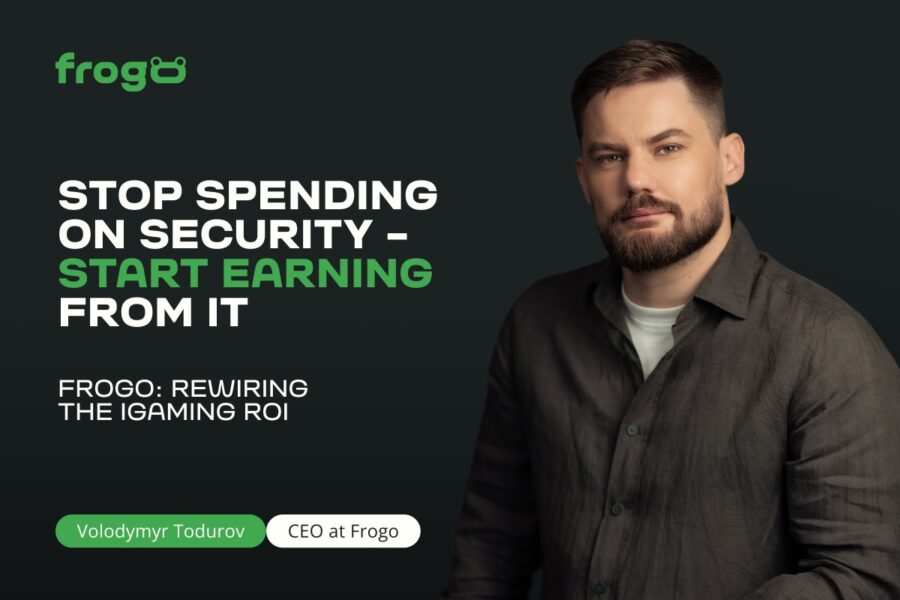

Focus Gaming News spoke with Frogo CEO Volodymyr Todurov about his “One Leap Ahead” philosophy, discussing how shifting risk management from a cost centre to a growth tool benefits operators.
Exclusive interview.- In the high-velocity world of igaming, anti-fraud departments have long been viewed as a necessary cost centre that burns through budgets to prevent losses, often at the expense of user experience. But as the industry matures, a new school of thought is emerging. At Frogo, CEO Volodymyr Todurov is shifting the focus of risk management. The goal is to move beyond simple protection and show how a solid security environment can create new opportunities for growth.
Focus Gaming News sat down with Volodymyr to discuss the “One Leap Ahead” philosophy, the death of scoring and why your biggest fraud alert might actually be your next big VIP opportunity.
The paradigm shift: From cost centre to profit engine
The industry traditionally views anti-fraud as a “cost centre” or a necessary evil. How does Frogo’s philosophy flip this script to make fraud prevention a genuine profit-generating engine?
It starts with a fundamental change in mindset. Most systems are built to catch “bad” actors, but they forget to facilitate the “good” ones. At Frogo, we use flexible, dynamic rules that allow us to skip unnecessary friction for genuine customers. This directly impacts your conversion and retention rates.
One of our core strengths is how we handle scoring. We recognise behavioural patterns – both fraud and VIP – simultaneously. Because these triggers run in parallel, the data isn’t just siloed in the anti-fraud team. It’s fed instantly to the retention, payments, VIP, and product teams.
Take a simple example: automation. Without Frogo, a PSP integration bug might result in a customer getting an abnormal deposit amount. They spend it, you lose the money, and you’re stuck paying game provider fees on “phantom” revenue. With Frogo, we freeze that balance automatically the moment the anomaly hits. We don’t just stop the theft; we stop the downstream operational costs that eat your margins.
The friction paradox: Protecting the VIP experience
In igaming, “friction” is the enemy. How do you ensure that tightening the net doesn’t accidentally drive away high-value players and legitimate traffic?
You can’t fly blind. We use a feature called the “Feedback Loop.” We monitor the actual decisions made by the operator’s team against the alerts our system triggers. This allows us to calculate the exact precision and recall for every single scoring policy.
Furthermore, our rules engine is surgical. We can create exclusions for any specific customer segment. Before a client goes live with a new hypothesis, we run notifications directly into their Telegram or Slack channels. This lets the team “shadow test” their thresholds in real-time before connecting them to automated decisions. We even run historical checks to show exactly how a new trigger would have affected past transactions. It’s about being a scalpel, not a sledgehammer.
The case study: When a “fraud” alert uncovered a growth goldmine
“Convert losses into profit” is a bold claim. Can you walk us through a scenario where your engine actually revealed a hidden growth opportunity?
This is a favourite of mine. We once flagged a pattern of users making repeated, high-value deposits without actually playing. To a basic system, this looks like classic AML risk – people using the casino as a money-transferring service.
Our analysis showed two distinct groups. Group A were indeed fraudsters. But Group B? They were trusted VIPs who were hitting new transaction limits on the PSP side. They wanted to play big, but the UX was so poor that they had to make five transactions just to get their starting bankroll on the site.
We alerted the VIP and Payments teams. They adjusted the PSP limits for that segment, and the retention team sent a targeted message to these VIPs about their “upgraded” limits. The result? The following week saw a quarterly historical maximum in VIP retention. We turned a “suspicious activity” alert into a high-tier loyalty win.
The boutique approach: Why “mass-market” fails in risk
Frogo positions itself as a premium, selective partner. Why choose a boutique, consultancy-heavy model in an era of mass-market SaaS?
Because one-size-fits-all is dangerous in risk management. Out-of-the-box scoring models are fine for the first week, but fraud evolves every hour. Anti-fraud is a daily operation.
You’re constantly launching new promos, opening new affiliate sources, or integrating new PSPs. Each of these changes the risk landscape. We aren’t just a software vendor; we are an extension of our clients’ teams. We fight for “operational excellence”, which means driving false positives and manual checks down to the absolute minimum. You can’t achieve that with a “one-size-fits-all” algorithm.
With bonus abuse and CPA fraud becoming more sophisticated, how does Frogo’s “One Leap Ahead” approach change the game for 2026?
The answer is true real-time scoring. You don’t need a report “next Monday” telling you that an affiliate sent you fraudulent traffic. You need an alert the second the deposit distribution hits an abnormal threshold.
Frogo provides the structure behind the snapshots. We don’t just highlight to you that a metric moved; we show you why it moved, who moved it, and how to stop the loss while keeping the player. In 2026, the winner isn’t the one with the biggest wall – it’s the one with the smartest gate.
Volodymyr and the Frogo team are proving that the Frogo isn’t just for show – it represents the agility required to survive in the modern igaming ecosystem. By blending AI-driven forecasting with a high-touch consulting approach, Frogo is effectively rebranding fraud prevention as a tool for business optimisation. In a world of predators, it pays to be the one who can see the whole pond.
By Focus Gaming News Editorial Team