



Niccolo Cassettari, Logifuture: “Dead hours are an opportunity; our products keep the turnover running 24/7”
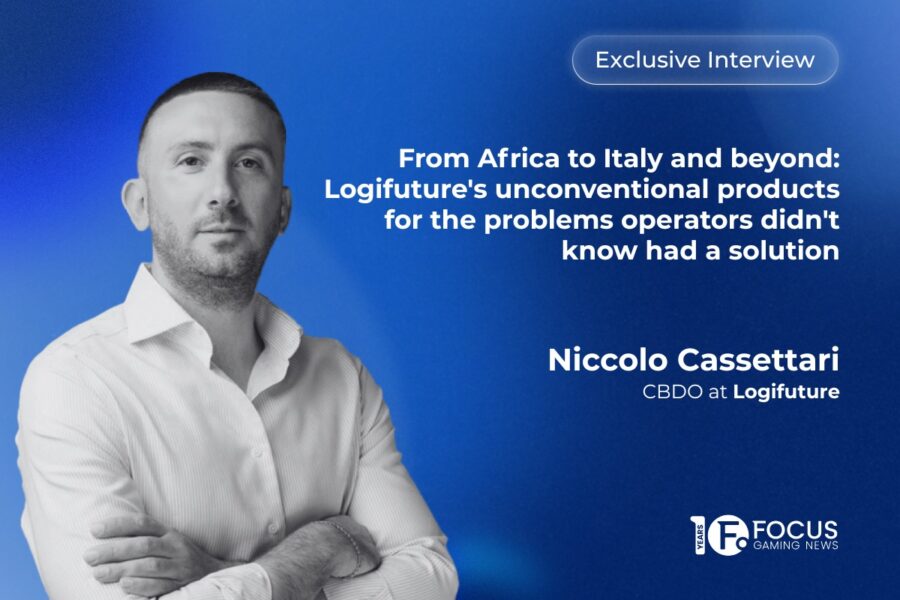

Niccolo Cassettari, CBDO at Logifuture, discusses the company’s expansion across Africa and Italy, virtual sports innovation and its strategy of developing products beyond conventional igaming offerings.
Exclusive interview.- With virtual sports, instant betting and mobile-first casino products, Logifuture is taking an unconventional approach to solving some of the engagement challenges facing operators across increasingly competitive markets.
In this exclusive interview with Focus Gaming News, Niccolo Cassettari, CBDO at Logifuture, discusses the company’s expansion across Africa and Italy, explaining how player behaviour and operator feedback shape its approach to localisation and product development. He also explores Zoom Sport, the company’s 24/7 virtual sports feed, and its role in filling the gaps between real sporting events.
Ahead of SBC Summit Lisbon and SiGMA Rome, Cassettari looks at Logifuture’s partnerships with tier-one operators, its plans for LatAm and the next stage of development for a company that has deliberately prioritised unconventional products over “me-too” solutions.
Logifuture has been expanding into new territories recently, with Africa and Italy as key markets. What’s driving that geographic focus, and what does each of those markets offer that others don’t?
Africa was our starting point — deepest operational experience, which is what let us move fast into Italy, a market we already understood well. This isn’t top-down expansion for the sake of it — it’s organic growth driven by product feedback. We have a broad portfolio, from virtual sports to casino games you won’t find anywhere else, and we adapt every one of them to the geography it lands in.
The real point: our products aren’t built to solve a “Kenya problem” or an “Italy problem.” They’re built to solve the challenges operators face everywhere — engagement gaps, off-peak dead time, cross-sell friction. Geography changes how we tune them, not what problem they solve.
Right now we’re deep in integration with tier 1 sportsbooks, feed providers and casino aggregators — that’s how we scale reach fast without slowing down on quality. And LatAm is very much on our radar next; the market dynamics there line up closely with what’s already worked for us in Africa.
“We have a broad portfolio, from virtual sports to casino games you won’t find anywhere else, and we adapt every one of them to the geography it lands in”.
Niccolo Cassettari, CBDO, Logifuture.
Africa is one of the fastest-growing regions in igaming but also one of the most complex to operate in. What were the biggest challenges in establishing a footprint there, and how did you navigate them?
Everyone talks about the obvious stuff — connectivity, localisation, payment rails. Real, but not the interesting part. We started in Africa by studying player habits first, then building around what players and operators actually needed — not what worked somewhere else and got copy-pasted in.
African bettors run on a different rhythm than European or LatAm players — there’s an expectation that something is always happening, not “check back later.” So we built an ecosystem around that: products that keep players engaged 24/7, improve the actual experience, and give operators more time-on-platform, not just more transactions.
The Italian market is highly regulated and extremely competitive. What does Logifuture bring to that environment that operators there aren’t getting from existing suppliers?
Italy is regulated, mature, and saturated with suppliers offering more or less the same thing. We didn’t go in with a better version of what’s already there — we went in with products the market hadn’t seen.
Simulate lets players bet on real teams, real markets, real competitions, but the outcome resolves in seconds instead of 90 minutes — instant, on-demand betting moments that sit alongside the traditional match, with turbo mode and skip-to-result built in. Swipe Games does something different again: lightweight, mobile-first casino mini-games with simple swipe-in, swipe-out mechanics, built specifically to pull sportsbook users into casino without disrupting their betting journey.
That’s the core of it: unconventional products, built for problems operators didn’t know had a solution yet.
“[In Italy] we didn’t go in with a better version of what’s already there — we went in with products the market hadn’t seen.”
Niccolo Cassettari, CBDO, Logifuture.
Zoom Sport is described as a feed of virtual events. Can you explain exactly what it is, how it works, and why operators should be paying attention to it right now?
Zoom Sport is a continuous virtual sports feed — full matches roughly every 90 minutes (turbo leagues every 10 minutes), running 24/7, with an entire season wrapped up in a day and a half to two days. Same market depth as a real match: prematch and live betting, same structure operators already know how to price and manage.
Why now: operators are sitting on dead hours — early morning, off-season, the gaps between real fixtures — and losing engagement in that time. Zoom fills it without operators lifting a finger operationally.
We released Zoom Tennis earlier this year, and Zoom Basket — virtual basketball — lands in Q3. Same feed logic, new sport, one more reason for basketball aficionado players to stay on the platform outside of scheduled real-world events.
The virtual sports category is crowded. What makes Zoom Sport stand out from what’s already in the market, and where does it perform best in terms of player engagement?
Most virtual products are built for virtuals players — a niche audience, separate from the sportsbook. Zoom isn’t. It’s built for sportsbook users, sits inside the sportsbook next to real leagues and matches, and is designed to resemble reality as closely as possible: additional leagues, additional tournaments, matches that never actually stop.
Real sport has a schedule. Weekends end, the lights go off, players wait until next week. Zoom doesn’t wait. When the real match ends, players still find their favourite teams playing — that’s where engagement holds and turnover follows. We’re seeing up to +20-30 per cent turnover uplift on sportsbooks running Zoom.
How do you see the virtual events space evolving over the next 12 months, and where is Logifuture placing its bets in terms of product development?
We keep building towards one thing: getting Zoom as close to the real-event feeling as possible. We’ll keep enriching the offer to track what’s actually happening in sportsbooks worldwide, and keep refining features around the betting experience itself.
What we won’t do is flood the market with more matches for the sake of more matches. This is a quality-over-quantity game — we’d rather make what we already have better than pile on volume nobody asked for.
You’ll be at both SBC Lisbon and SiGMA Rome. What are your main objectives at each event, and what conversations are you most looking forward to having?
We’re already integrating with a lot of tier 1 partners, so these events are less about first introductions and more about solidifying those relationships — and finding the right new strategic partners, not the most partners. Same philosophy as the product: quality over quantity.
Practically, that means sitting down face to face, showing partners what’s coming next, and having the kind of conversation that doesn’t happen over email — a proper coffee and a real discussion about what operators actually need next.
Looking at Logifuture as a company today versus 12 months ago, what’s the most significant change, and what does the next chapter look like?
We changed gear. The last year has been about planting seeds — building products that don’t fit the standard mould and showing operators the actual benefit, not just the pitch. That takes longer than launching something familiar. Unconventional products don’t get an immediate reaction — the market needs time to catch up. But that’s exactly what quality work looks like.
In 2026, those seeds are becoming plants. We made a deliberate choice not to ship standard, me-too products, because we believe innovation has to sit at the core of the business if you want to build something that lasts — not just win a quarter.
By Focus Gaming News Editorial Team