How Malta’s 2018 Gaming Act reshaped igaming

Focus Gaming News examines how a 2018 legislative reform turned Malta into the reference licensing jurisdiction for the global igaming industry, and why that status is being tested again in 2026.
Key takeaways:
- The Malta Gaming Authority (MGA) consolidated its fragmented regulatory framework into a single, technology-neutral law by introducing the 2018 Gaming Act.
- The 2018 reform simplified the jurisdiction’s structure into B2C (Gaming Service) and B2B (Critical Gaming Supply) licences.
- The igaming sector currently generates 6.3 per cent of Malta’s GDP, with the MGA overseeing more than 500 licensed companies.
- Industry suppliers, including Play’n GO and Altenar, maintain that an MGA licence serves as a crucial global benchmark for operational discipline and player trust.
- To remain competitive amid localised global regulations, the MGA’s 2026 supervisory efforts prioritise crypto-asset controls, player protection, and sports betting integrity.
Malta’s 2018 Gaming Act transformed a fragmented licensing system into a technology-neutral framework that helped establish the island as a global igaming hub. Eight years on, the model is being tested by increasingly fragmented regulation, new technologies and evolving player-protection risks.
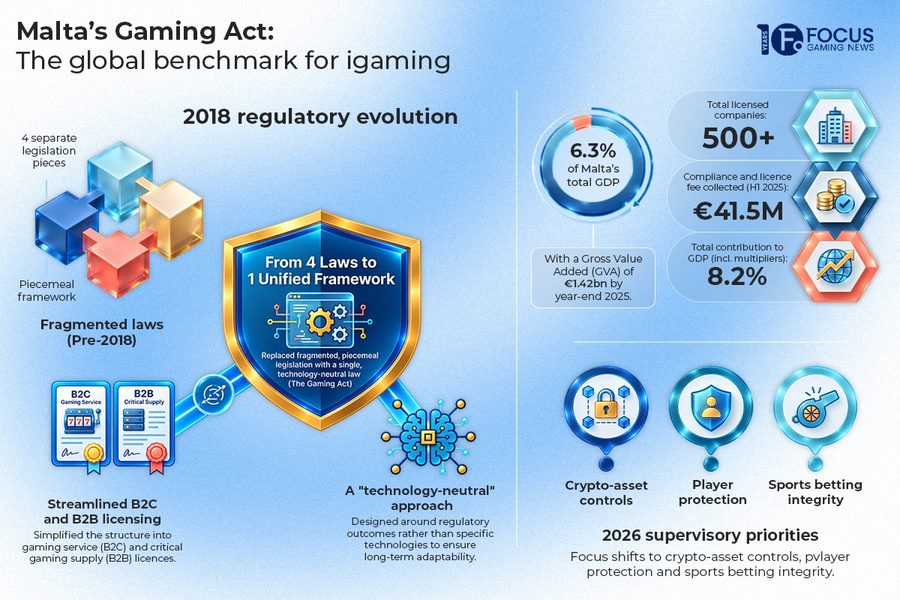
Special report.- On August 1, 2018, the Malta Gaming Authority (MGA) replaced four separate pieces of gaming legislation with a single law, the Gaming Act (Cap. 583), consolidating a licensing regime that had been built piecemeal since 2004 into one technology-neutral framework. Eight years later, the sector generates 6.3 per cent of Malta’s GDP and hosts more than 500 licensed companies, and the reform is still cited by regulators and operators as the moment Malta stopped being simply an early mover in remote gaming and became the industry’s long-term reference jurisdiction.
This is the fifth in a series of special articles analysing how the gambling industry has evolved over the past decade, the challenges it has faced and what the future holds. In this instalment, Focus Gaming News examines why the 2018 reform mattered, how operators and the regulator itself describe its impact, and how the framework has had to adapt since.
What were the limitations of Malta’s pre-2018 framework?
Malta has a regulatory head start. In 2004/2005, it became the first EU member state to introduce a dedicated legal framework for remote gaming, years ahead of most of the bloc. But that early framework grew by addition rather than by design, as new rules layered on top of old ones as different verticals and technologies emerged, instead of as a single coherent structure built from the outset.
By the mid-2010s, that patchwork was showing its age. Asked about the state of the sector before the reform, a spokesperson for the MGA told Focus Gaming News: “Prior to the introduction of the Gaming Act in 2018, Malta’s gaming regulatory framework had served the jurisdiction well for many years, but the industry had evolved significantly. The sector was becoming increasingly digital, international and complex, with new technologies, business models and cross-border operations emerging at pace. At the same time, expectations around consumer protection, responsible gambling, anti-money laundering controls and regulatory oversight were increasing.”
That combination is what made a full overhaul necessary rather than another round of incremental amendments. “As the sector matured, it became important to ensure that the regulatory framework remained fit for purpose and capable of responding effectively to emerging opportunities and risks,” the spokesperson said. “There was also a need for a framework that could adapt more readily to future developments in a fast-moving industry.”
What changed with the 2018 Gaming Act?
According to the MGA, one of the most consequential decisions during the reform was to move away from technology-specific regulation altogether. “One of the most significant aspects of the 2018 reform was the adoption of a more streamlined, technology-neutral and risk-based regulatory approach,” the Authority explained. “Rather than regulating around specific technologies, the framework was designed around regulatory objectives and outcomes, making it better equipped to adapt to innovation and evolving business models without requiring constant legislative change.”
The licensing structure reflected that principle. “A particularly impactful change was the simplification of the licensing structure,” the spokesperson said. “The reform introduced two main licence categories: the Gaming Service Licence (B2C) and the Critical Gaming Supply Licence (B2B), applicable across both online and based across both onlñine and land-based sectors. This replaced a more fragmented licensing regime and enabled a more proportionate application of regulatory requirements based on the nature of the activity and the risks involved.”
The second structural pillar was a three-tier legal hierarchy composed of the Gaming Act, subsidiary legislation and binding instruments. “This provided a clear and robust legal foundation while giving the Authority greater flexibility to respond to developments in the sector through more targeted regulatory instruments where necessary,” the MGA said — a design choice that, eight years later, is the reason the Authority credits the Act with still being fit for purpose without a further legislative rewrite.
Why do operators choose Malta?
For companies deciding where to base their licensing and compliance infrastructure, the 2018 reform reinforced something Malta had already spent over a decade building: predictability. Shawn Fluharty, head of government affairs at Play’n GO, argues that the value of an MGA licence goes beyond market access. “Holding a licence from the Malta Gaming Authority should mean more than simple market access,” he told Focus Gaming News. “It should stand for regulatory seriousness, operational discipline, and a genuine commitment to player protection. For us, that matters enormously, because Play’n GO has been very clear about the kind of industry we want to help build: one rooted in high standards, strong oversight, and long-term sustainability, not short-term opportunism.”
Fluharty ties that principle directly to commercial decisions the company has made, including refusing to offer Bonus Buy features where they are permitted and publicly ruling out supplying sweepstakes casinos. “So for us, an MGA licence is valuable only insofar as it reflects and reinforces those standards,” he said. “The real issue is not whether a regulator is historically well regarded; it is whether it continues to demand the level of integrity the future of this industry requires.”
Asked why Malta became the company’s licensing base, Fluharty pointed to the jurisdiction’s role in shaping the wider regulatory conversation: “Malta became influential because it was one of the jurisdictions that helped define what modern igaming regulation could look like.” However, he was careful to frame that influence as something that has to be renewed rather than assumed: “Prestige in this industry cannot be taken for granted. It has to be earned continuously. Regulatory leadership is not a legacy asset; it is something that must be renewed through clear standards, strong enforcement, and a willingness to confront new risks before they undermine confidence in the wider model. That is true for Malta, and it is true for every major regulator around the world.”
Vagelis Bairlis, head of sales operations at Altenar, describes a more operational version of the same value proposition. “For Altenar, holding an MGA licence is much more than a regulatory requirement, it is a clear demonstration of how we operate,” he said. “It shows our clients that our platform, internal processes, compliance framework, and governance have been assessed against one of the industry’s most respected regulatory standards.” Bairlis added that this assurance has practical commercial value: “In an industry where compliance is a key factor in supplier selection, this level of assurance helps reduce barriers during the procurement and due diligence process.”
On why Altenar chose Malta, Bairlis noted that “Malta has long been recognised as one of the most respected and mature igaming jurisdictions globally. The MGA combines clear regulatory standards with a pragmatic approach that supports innovation while maintaining strong player protection. For Altenar, it was the natural choice to align our business with a regulator that is widely recognised across the industry.” He credits the licence with tangibly accelerating the company’s expansion: “It has helped us accelerate partnerships with established brands and enter commercial discussions in multiple regulated jurisdictions with a recognised regulatory credential already in place.”
How has the MGA adapted its supervisory model to crypto-assets and new technology?
The Gaming Act’s technology-neutral design was tested early by the rise of virtual financial assets (VFAs) and distributed ledger technology (DLT). “The 2018 reform introduced a technology-neutral and risk-based regulatory framework, which has enabled the MGA to adapt its supervisory approach as new technologies, payment methods and business models have emerged,” the Authority explained. “Rather than creating separate regulatory regimes for each new innovation, the framework allows the Authority to assess and address risks based on the activity being undertaken and its potential impact on player protection, market integrity and financial crime risk.”
That approach produced a distinctive feature of Malta’s supervisory model: a live sandbox for regulated digital-asset use. “Malta’s regulatory framework enabled the Authority to engage with these developments at an early stage through guidance on the use of DLT and the acceptance of virtual assets, which subsequently led to the introduction of a sandbox environment for licensed operators,” the spokesperson said. “This allowed digital asset payment solutions to be tested within gaming operations under enhanced safeguards, while giving both the Authority and licensees valuable practical experience.”
That experience eventually informed a formal policy, timed deliberately around a broader shift in the EU law. “The experience gained, together with targeted stakeholder engagement, informed the MGA’s Policy on the Use of Distributed Ledger Technology, which reflects several years of supervisory experience and places greater emphasis on licensees’ governance, policies and procedures,” the MGA said. “The policy was also developed in anticipation of the EU’s Markets in Crypto-Assets Regulation (MiCA), helping to facilitate a smooth transition from Malta’s existing national framework to the EU-wide regime.”
What are the MGA’s priorities in 2026?
The same risk-based logic now shapes how the MGA is approaching a new set of questions that did not exist in any recognisable form in 2018: prediction markets, further crypto-asset exposure and sports betting integrity risk. “The discussions currently taking place around areas such as prediction markets, crypto-assets and sports betting integrity reflect the increasingly dynamic and interconnected nature of the gaming sector,” the Authority said. “The industry today looks very different to that of a decade ago, and regulators must continue to evolve in step with those developments.”
Those priorities are formalised in the Authority’s Supervisory Engagement Efforts for 2026, built around three themes:
- Compliance: Including thematic reviews of internal controls around the use of cash, cash equivalents and crypto-assets.
- Player protection: With enhanced oversight of the quality and consistency of operators’ monthly ADR reporting.
- Sports betting integrity: With focused reviews on athletes betting on their own sport and integrity risks associated with esports markets.
How important is igaming for Malta’s economy?
The numbers put a scale on what “reference jurisdiction” means in practice. According to the MGA’s Annual Report for the year ending December 31, 2025, the gaming industry generated 6.3 per cent of Malta’s GDP that year, with a Gross Value Added (GVA) of €1.42 bn, up 3.5 per cent on the previous year; factoring in multiplier effects across the wider economy, the sector’s total contribution rises to an estimated 8.2 per cent.
In the first six months of 2025 alone, the Authority collected €41.5 m in compliance contributions, licence fees and related dues. The MGA received 28 new licence applications in that same six-month period, on top of a base of over 500 licensed gaming companies.
Does Malta’s model hold up against newer jurisdictions?
When asked about the biggest vulnerability facing the Maltese model, the MGA pointed to the “increasingly fragmented global regulatory landscape,” as more jurisdictions introduce their own frameworks and “the role of established gaming jurisdictions such as Malta continues to evolve.” In the Authority’s words: “As more markets move towards local regulation and supervision, jurisdictions must continue to ensure that they offer value beyond the licence itself.”
Malta’s answer to that pressure, according to the Authority, lies in an ecosystem built over two decades rather than in the licence alone. “Malta’s strength lies in the fact that it has evolved beyond being simply a licensing jurisdiction,” the spokesperson said. “Over more than two decades, it has developed a mature ecosystem composed of industry, regulator, and service providers, underpinned by deep sector expertise and a stable political outlook that supports the industry’s presence in the country.
This ecosystem has become one of Malta’s defining strengths and remains difficult to replicate elsewhere. The MGA pointed specifically to recent VAT-related fiscal reforms and an expanded Highly Skilled Individuals scheme, alongside a growing B2B footprint of technology and platform providers, as reinforcing that ecosystem.
Bairlis frames the same shift from the supplier side, as the MGA licence remains “widely recognised as one of the most respected regulatory credentials in the global gaming industry,” but its value today rests on Malta continuing to be independently rigorous, not on historical reputation alone.
Fluharty adds: “As more markets regulate, established frameworks still matter, but only if they continue to lead. The future of licensing will not be determined by history alone. It will be determined by who is prepared to set clear global benchmarks around player protection, compliance, product standards, and the distinction between sustainable regulation and regulatory grey zones.” In his view, the next phase of global igaming regulation will judge jurisdictions less by how open they are and more by “how seriously they protect the credibility of the regulated model itself”.
Frequently asked questions (FAQs)
- What changed with Malta’s Gaming Act in 2018?
The Gaming Act replaced four separate pieces of gaming legislation with a single technology-neutral, risk-based framework and simplified the licensing structure. - Why is Malta important to the global igaming industry?
Malta was the first EU member state to introduce a dedicated remote gaming framework and has since developed a mature ecosystem of operators, suppliers and regulatory services. - How much does gaming contribute to Malta’s economy?
The gaming industry generated 6.3 per cent of Malta’s GDP in 2025, with a gross value added of €1.42bn. - What are the MGA’s main regulatory priorities in 2026?
The MGA is focusing on compliance around cash and crypto-assets, player protection and sports betting integrity, including risks linked to athletes and esports.
This article is the fifth instalment of a series produced by Focus Gaming News to mark its tenth anniversary. Over the course of 2026, the articles will examine the most defining moments that shaped the global igaming industry between 2016 and 2026, from regulatory changes and market openings to technological shifts and the rise of new regions. Each piece will be accompanied by exclusive interviews with the executives, regulators and analysts who were part of these changes.
By Focus Gaming News Editorial Team