



Luka Pataky, Bragg Gaming Group: “I strongly believe AI will become an intrinsic part of the igaming experience”
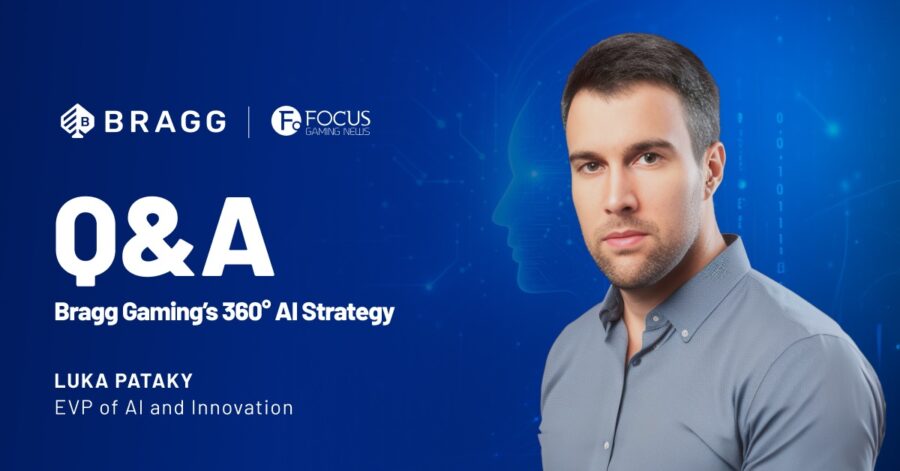
In an exclusive interview with Focus Gaming News, Luka Pataky discussed his new role as Executive Vice President of AI and Innovation at Bragg Gaming Group.
Exclusive interview.- In July, Bragg Gaming Group announced the appointment of Luka Pataky as executive vice president (EVP) of AI and Innovation.
During Pataky’s introduction, the company said that this strategic addition to the executive team is part of its commitment to the leveraging of data, advanced analytics and powerful AI to enhance user experience, player engagement, maximise revenue potential, and drive smarter, more efficient igaming operations.
To learn more about Pataky’s role at Bragg Gaming Group, the 360-degree artificial intelligence strategy he plans to develop within the company, and his vision for the coming years, Focus Gaming News sat down with him for an exclusive interview.
Congratulations on your new role! What excites you most about leading AI and innovation at Bragg Gaming Group?
What excites me most about leading AI and Innovation at Bragg Gaming Group is the clear opportunity to integrate Artificial Intelligence as a core component across the organisation. It’s not simply about adding new features; it’s about systematically enhancing how we operate and how we deliver value to our players and partners.
I’m particularly motivated by the prospect of driving measurable business impact through AI, widely across the whole organisation. My experience has consistently focused on ensuring AI serves as a practical enabler of growth and efficiency. At Bragg, I see significant potential to leverage AI for more tailored player experiences, moving beyond basic segmentation to provide relevant content and offers. Additionally, advanced analytics can inform strategic product development and more effective player retention efforts. My passion for data is a key driver; Bragg possesses a substantial amount of data, and the opportunity to transform this data into actionable insights – insights that directly inform product strategy, improve player experiences, and optimise operations – is genuinely exciting.
Beyond the technology itself, I’m eager to build and empower capable, collaborative teams that will bring this vision to fruition. The environment at Bragg, bringing together diverse expertise, is fertile ground for practical innovation. I look forward to fostering a culture of experimentation and continuous improvement that allows us to identify and implement impactful AI solutions efficiently.
“At Bragg, I see significant potential to leverage AI for more tailored player experiences, moving beyond basic segmentation to provide relevant content and offers.”
Luka Pataky, Bragg Gaming Group Executive Vice President for AI and Innovation.
You have mentioned a 360° AI strategy, can you share what that means in practice, and how it will reshape Bragg’s product and player experience?
A 360° AI strategy at Bragg means Artificial Intelligence is deeply integrated into our operations, products, and customer interactions, rather than being an isolated initiative owned by one team. In practice, AI becomes a foundational layer, optimising every touchpoint to create a more intelligent ecosystem.
This holistic approach will reshape Bragg’s product and player experience. For our products, a 360° AI strategy means developing more intelligent offerings. Things like predictive analytics from early development to identify market trends, forecast potential game feature success, and even explore automating aspects of content creation. This helps us build products more responsive to market demands and player preferences, accelerating innovation.
For the player experience, a 360° AI strategy unlocks advanced personalisation and engagement. AI enables more tailored experiences, adapting game discovery, offers, support, and possibly even the interface. This aims to create a highly relevant and engaging environment. Crucially, this view extends to responsible gambling: AI integrates across player data to identify subtle patterns that might indicate problematic behaviour, allowing for more timely and precise interventions. This helps us strengthen our social responsibility efforts, contributing to a safer gaming environment. Finally, AI can enhance internal workflows by automating repetitive tasks, empowering employees to focus on higher-impact, strategic activities.
“AI integrates across player data to identify subtle patterns that might indicate problematic behaviour, allowing for more timely and precise interventions.”
Luka Pataky, Bragg Gaming Group Executive Vice President for AI and Innovation.
Coming from your experience at Sportradar, where you scaled AI systems to cover 300,000+ events annually, what key learning are you bringing into this new chapter at Bragg?
My experience at Sportradar, particularly in scaling AI systems to handle a massive volume of data and events, provided invaluable lessons directly applicable for Bragg’s strategic growth. This extensive scaling wasn’t just a technical feat; it was a masterclass in operationalising AI for business impact.
The primary learning is the absolute necessity of linking every AI initiative to tangible business value and operational efficiency, especially at scale. This may sound obvious, but we often see ‘tech for tech sake’ initiatives. When dealing with vast quantities of data and operations, AI must be a core driver of revenue generation, cost optimisation, or enhanced data depth. This taught me to relentlessly prioritise use cases that deliver ROI, even if they take longer to mature. It’s about building solutions that don’t just work, but work at volume and deliver measurable results. And the path was no easy one – it involved a lot of alignment, expectation management and visionary thinking.
Secondly, achieving such scale requires a well-defined AI/ML development process and extremely robust and accessible data. Managing extensive datasets and numerous models in real-time highlighted the critical need for automated pipelines, careful model oversight, and continuous performance monitoring. It all starts and ends with data, and your ability to track experiments and have the ability to understand how data impacts the results.
Finally, scaling AI underscores the vital role of building and supporting effective, cross-functional teams. My experience involved fostering collaboration among data scientists, engineers, product managers, and operations teams, many times across the borders of my own team, to ensure seamless integration. This also means, and that may be the most important element of success in Corporate AI, recognising that AI is not just a departmental function; it’s a cultural shift and a mindset. Successful AI adoption requires everyone across the organisation to understand its potential and stand behind its implementation.
How do you see AI contributing to safer gambling and more responsible player engagement in the near future?
The core contribution of AI here lies in its unparalleled ability to process and analyse vast quantities of behavioural data in real-time, identifying patterns that are simply too subtle or complex for human observation. This allows us to move beyond reactive measures to proactive interventions. For instance, AI can be trained to detect early indicators of problematic play, such as sudden changes in betting patterns, increased session durations, or shifts in game types, long before these behaviours escalate. This precision enables us to trigger timely, personalised, and empathetic communications or interventions, guiding players towards safer habits or necessary support resources, rather than waiting for issues to become severe.
AI can enhance responsible player engagement by personalising the player’s experience in a way that inherently promotes healthier habits. By integrating AI across all player touchpoints, we gain a holistic view that allows us to not only identify potential risks but also to nurture a safer gaming environment. This capability strengthens an operator’s social responsibility, building greater trust with players and regulators alike, and ultimately contributing to a more sustainable igaming industry.
As Bragg aims to become an AI-first company, what does success look like for you 12 months from now, and what will the industry notice first?
For me, success in 12 months for Bragg’s AI-first ambition looks like having a clearly defined and actively implemented AI strategy that is genuinely embraced across the organisation. This means establishing robust processes for AI development and deployment, fostering a culture where data-driven decision-making is the norm, and empowering our teams with the tools and understanding to leverage AI in their daily work. Success will be evident in the tangible progress we’ve made in integrating AI into our core operations, leading to more efficient workflows and a more agile approach to innovation.
What the industry will notice first will likely be the enhancements in our product offerings and the player experience. This could manifest as more intelligently personalised content and game recommendations, impactful improvements in game mechanics and operational efficiency. Furthermore, our strengthened capabilities in responsible gambling, powered by AI’s ability to analyse vast amounts of data to detect patterns, will surely draw positive attention, too.
It’s about truly demonstrating that AI is not just a buzzword for us, but a strategic imperative that delivers real value and positions Bragg at the forefront of the igaming industry’s evolution. It’s certainly going to be a busy, but incredibly exciting year ahead.
Looking ahead five years, what role do you believe AI will play in shaping the next generation of igaming, and what is Bragg’s ambition in leading that transformation?
In today’s world of AI advancement, I would not dare to say where we will be in five years knowing where we were just two years ago! I strongly believe AI will become an intrinsic part of the igaming experience, driving a new era of intelligent and highly personalised engagement. We’ll see AI enabling sophisticated hyper-personalisation, dynamically tailoring every aspect of a player’s journey, from game recommendations to interface layouts. AI will also power advanced predictive analytics for game development, operational forecasting, and responsible gambling.
Bragg’s ambition is to be at the forefront of this transformation. This means consistently attracting top talent, continuously innovating to meet evolving player habits across generations, and embedding technology deeper into our core operations and product offerings. Bragg aims to set new industry standards and be recognised as a leader in shaping the future of igaming.
By Focus Gaming News Editorial Team