Khalid Ali, IBIA: “Tournaments like the 2026 FIFA World Cup activate the strongest integrity frameworks currently in place”
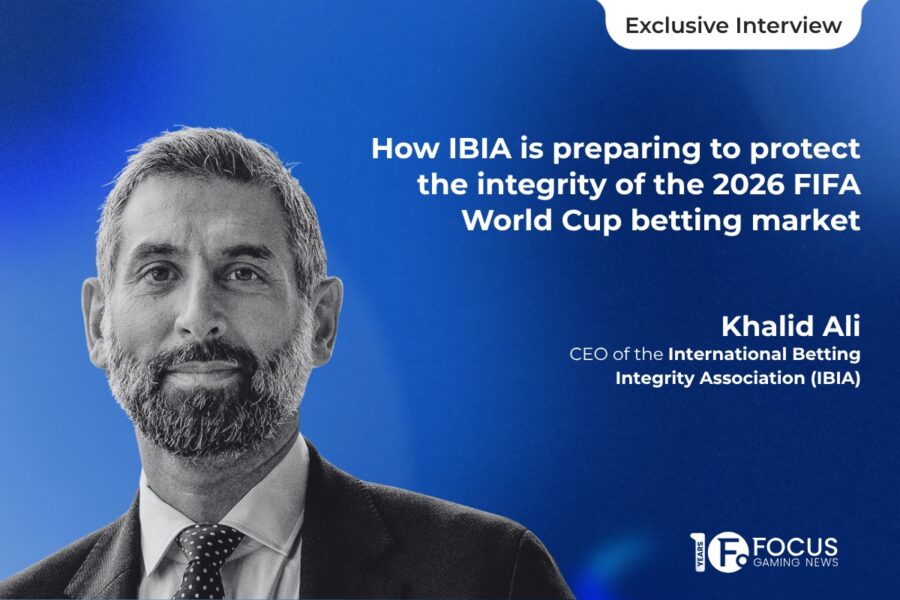

Khalid Ali, CEO of the International Betting Integrity Association, shares his thoughts on the upcoming FIFA World Cup and how the association is preparing for the tournament.
Exclusive interview.- The 23rd edition of the FIFA World Cup will kick off on June 11 at the Estadio Azteca in Mexico City, with hosts Mexico facing South Africa in the opening match. The sport’s flagship event features significant changes this year: 48 teams will participate for the first time, up from 32, and the tournament will be hosted across three countries: Canada, Mexico and the United States.
The tournament attracts one of the largest audiences in the sports betting sector and has therefore drawn the attention of sports betting operators, regulators, associations, governments and FIFA itself worldwide. The aim is to prevent risks, illegal markets, match-fixing and the misuse of technology.
The International Betting Integrity Association (IBIA) is part of this ecosystem, and Focus Gaming News spoke to its CEO, Khalid Ali, to find out more about how they are preparing for the tournament.
Looking ahead to the 2026 FIFA World Cup, which integrity risks worry you most from a betting perspective, and how is IBIA preparing for that?
We expect the 2026 FIFA World Cup to generate unprecedented global betting activity, driven by the continued expansion of regulated markets and increased accessibility across jurisdictions. Unfortunately, that growth will also include the unregulated betting market, which lacks regulation, oversight and effective monitoring and reporting provisions, and is where most of the potential integrity risks reside.
However, it is also important to stress that tournaments of this magnitude also activate the strongest integrity frameworks currently in place. FIFA has significantly strengthened its integrity architecture through its Integrity Task Force, which brings together all six confederations alongside key international stakeholders, including IBIA. That coordinated approach is essential given the global nature of betting markets.
From IBIA’s perspective, preparation is about readiness across systems, people and partnerships. Our Global MAP is calibrated for high-volume and high-velocity betting activity, and we are reinforcing communication channels with FIFA, regulators, law enforcement and other task force partners.
The objective is not simply to monitor, but to ensure that suspicious activity can be quickly identified, assessed and acted upon, supported by clear escalation pathways and trusted cooperation.
New technologies – particularly AI and more complex, in-play betting products – will shape the 2026 World Cup betting landscape. From IBIA’s perspective, do you see AI as more of a threat vector for match fixing and betting manipulation, or as a tool that significantly strengthens early detection and prevention?
AI should be seen as both a potential risk and a significant opportunity, but with the greater long-term value clearly on the side of detection and prevention.
While advanced tools could be used by bad actors to analyse markets or identify perceived vulnerabilities, the more important point is that AI significantly enhances the ability of regulated operators and monitoring bodies to detect anomalies, assess risk and respond quickly.
At the scale of a World Cup, that capability is critical. AI supports faster analysis, more accurate identification of suspicious patterns and more efficient coordination across jurisdictions. When combined with account-level data and structured reporting frameworks, it strengthens the overall integrity system.
That said, technology is not a substitute for good governance and regulation. The most effective model remains one where advanced tools sit within strong regulatory frameworks, supported by cooperation, information sharing and preventative measures.
“Technology is not a substitute for good governance and regulation.”
Khalid Ali, CEO of IBIA.
North America now accounts for a growing share of your alerts, and IBIA’s services meet regulatory requirements in 32 U.S. states and Ontario. As the region prepares to host the 2026 World Cup, do you believe its current regulatory frameworks and integrity tools are fit for purpose, given the expected surge in betting volumes, and where do you still see gaps?
North America has made substantial progress in building a well-regulated and monitored betting environment, and the integration of integrity services into regulatory frameworks provides a strong foundation ahead of the World Cup.
However, “fit for purpose” should not be confused with “complete”. The expected betting volumes will test the effectiveness of monitoring and reporting requirements, the speed of cross-border information sharing and the level of coordination between operators, regulators, sports bodies and law enforcement.
The remaining gaps are therefore not about the absence of tools but about alignment. Differences in regulatory approaches across jurisdictions can create friction in how quickly intelligence is shared and acted upon.
A tournament of this scale will reward systems that are not only robust but also well coordinated, with clear reporting standards and the ability to respond rapidly across borders. Having engaged successfully with the FIFA Integrity Task Force for previous tournaments, we are confident that IBIA’s protocols will continue to prove robust and effective.
Based on your historical data, where in the World Cup cycle do you see the highest vulnerability, and will IBIA’s monitoring intensity change across those phases?
IBIA views integrity risk across the full World Cup cycle rather than focusing solely on the final tournament. That is why IBIA and its members’ approach is based on continuous monitoring and market risk assessment.
While the finals attract the highest level of scrutiny and oversight, earlier phases such as qualifiers, friendlies and preparatory competitions can present vulnerabilities if integrity frameworks are less consistent or less visible. In some cases, those environments may be perceived as offering greater opportunity due to lower levels of attention.
Monitoring intensity will naturally increase as the tournament approaches and betting volumes rise, with more focused analysis and closer coordination across stakeholders. The key principle is proactive preparedness, ensuring that integrity measures are in place well before the tournament begins, rather than being concentrated only on the final stages.
“IBIA views integrity risk across the full World Cup cycle rather than focusing solely on the final tournament.”
Khalid Ali, CEO of IBIA.
After the 2026 World Cup, how will you measure whether integrity protections were successful, and what would a “successful” integrity outcome for IBIA look like?
From IBIA’s perspective, a successful outcome is one where betting markets are closely and credibly monitored, stakeholders work seamlessly together, and any suspicious activity is either deterred, identified early or addressed effectively. In many respects, the best outcome is one where the tournament concludes with strong confidence in the integrity of both the sport and the betting markets, supported by a system that functioned as intended throughout.
By Focus Gaming News Editorial Team