

Karina Moral, Zenith: “Moving a land-based player online is not simply a change of channel”
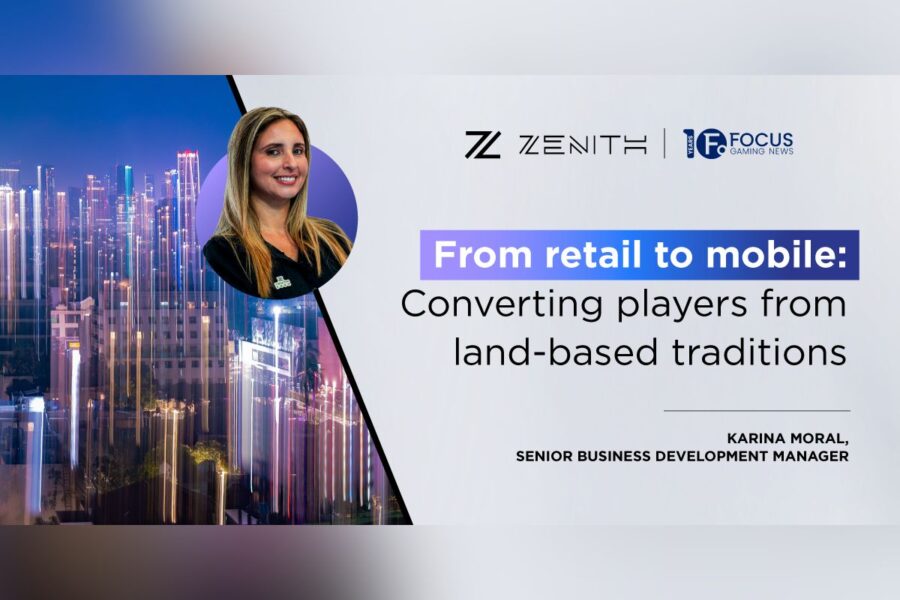

Karina Moral, Senior Business Development Manager at Zenith, sat down with Focus Gaming News to discuss how LatAm’s retail gambling heritage is shaping operators’ strategies for moving players into igaming.
Exclusive interview.- Latin America’s strong land-based gambling heritage continues to influence how players approach online gaming, creating both opportunities and challenges for operators moving established audiences into digital environments. Familiarity, trust, payments and content all play a role in determining whether that transition becomes a successful long-term relationship or an early drop-off in the conversion funnel.
In this exclusive interview with Focus Gaming News, Karina Moral, senior business development manager at Zenith, explains why operators need to look beyond simply replicating the retail experience online. She discusses the importance of reducing friction around registration, KYC and payments, while using data to guide progressive content discovery and create mobile experiences that feel intuitive to players entering digital for the first time.
Moral also explores what meaningful localisation looks like across markets such as Brazil, Mexico and Colombia, and how Zenith’s OneAPI, GamesAPI, real-time analytics and localised infrastructure can help operators adapt their content strategies quickly while maintaining a seamless player experience.
Latin America still has some of the strongest land-based gambling cultures in the world. In your experience working across the region, how much does that retail heritage shape what players expect when they move online?
The retail heritage runs deeper than most operators account for when planning a digital entry strategy because moving a land-based player online is not simply a change of channel. It is a fundamental shift in how that player relates to the product, the brand and the act of gambling itself, and the industry has a tendency to underestimate just how significant that shift feels from the player’s side.
Retail players are accustomed to familiarity, immediacy and trust. They understand the environment, they recognise the games and they know exactly how they will get paid. A player who has spent years handing cash to someone at a location they know and trust is now being asked to register on a platform, complete KYC, make a digital deposit and trust that a withdrawal will arrive. That is a much bigger behavioural shift than it might appear from the operator’s side of the table.
The digital journey needs to recreate the things that made retail feel comfortable which means recognisable content, simple navigation, familiar payment methods, fast withdrawals and a clear sense that the platform is trustworthy. This is also where the differences between markets become critical, because Brazil, Mexico, Peru, Colombia and Argentina may share cultural characteristics but player behaviour, payment habits and content preferences can be very different from one market to the next.
The transition from physical to digital is rarely as straightforward as operators assume. Where do you most commonly see operators lose players during that shift and what is usually behind it?
The biggest drop-offs happen when operators introduce too much friction too early. Registration and KYC are obvious examples but payments are probably the most underestimated part of the conversion funnel. If a player reaches the deposit stage and does not see a payment method they recognise or trust, you lose them immediately. The same applies to withdrawals. In LatAm, the speed of a withdrawal is not only a payment issue; it is a trust issue.
Another common problem is product overload. Online gives operators access to thousands of games but more content does not automatically create a better experience. A retail player accustomed to choosing from a relatively limited number of familiar games can land on a casino homepage with thousands of titles and dozens of categories and that volume can reduce conversion rather than improve it. The better approach is progressive discovery. This means starting with recognisable mechanics and familiar content, understanding what that player is engaging with and then introducing new games based on actual behaviour rather than assumption.
“Online gives operators access to thousands of games but more content does not automatically create a better experience.”
Karina Moral, senior business development manager at Zenith.
Mobile is now the dominant channel across LatAm but the habits of a land-based player are not naturally mobile-first. How should operators be thinking about their product and content strategy when targeting this specific audience?
The mistake operators make most consistently is treating mobile-first as a design constraint rather than a strategic starting point. Compressing a desktop casino onto a smaller screen solves the wrong problem. For a retail player making their first move into digital, the experience needs to be built around simplicity, speed and discoverability because a player who cannot find something familiar within the first few seconds is unlikely to give the platform a second chance.
Data has to do more work than operators typically allow it to. Personalised recommendations, recently played titles and locally trending games need to surface immediately rather than sitting deep in a catalogue the player has no framework for navigating. Zenith’s real-time analytics dashboard gives operator partners exactly that visibility, showing what is performing, what is being ignored and where engagement is dropping off, so content decisions are based on live behaviour. Performance matters just as much, and this is something operators entering LatAm consistently underestimate. Connectivity and device capability vary considerably across the region and a game that performs beautifully on a high-spec handset may be commercially irrelevant on the devices most players are using day to day, which is why Zenith’s localised server infrastructure across LatAm is built specifically to keep load times low regardless of network conditions.
Localised content is often talked about as important but rarely defined precisely. When it comes to converting retail players into loyal digital users, what does localisation look like in practice and how does it differ market by market?
Localisation runs far deeper than translating a platform into Spanish or Portuguese. Content, payments, UX and communication all need to be approached differently depending on the market and getting any one of them wrong can undermine the entire conversion strategy. Brazil has developed its own distinct digital gaming culture, where particular mechanics have become culturally embedded and the regulatory environment now demands certified content alongside player preference. Mexico is a different proposition entirely, where retail and cash-based habits still carry significant weight and bridging physical familiarity with digital convenience remains one of the most important conversion levers. In Colombia, where the regulated market is more mature, localisation has shifted away from educating players about online gaming and towards content relevance and retention.
Payments tell the same story. PIX in Brazil, PSE in Colombia and SPEI alongside cash-linked methods like OXXO in Mexico illustrate clearly why a single regional payment strategy does not hold up in practice. Through OneAPI and GamesAPI, Zenith gives operators the infrastructure to act on that reality, accessing locally relevant content across multiple markets through a single integration rather than rebuilding their approach from scratch every time they enter a new jurisdiction.
“Localisation runs far deeper than translating a platform into Spanish or Portuguese.”
Karina Moral, Senior Business Development Manager at Zenith.
For operators making the retail-to-digital push, how do Zenith’s OneAPI and GamesAPI specifically help them get the right content in front of the right players quickly?
One of the biggest challenges for an operator moving from retail into digital is that the content requirement changes dramatically. They suddenly need broader portfolios, different suppliers, different mechanics and the ability to react quickly when player preferences shift. If every provider requires a separate commercial and technical integration, adapting the casino becomes slow and expensive.
With OneAPI, operators integrate once and gain access to a much broader ecosystem of content rather than building and maintaining multiple individual integrations. GamesAPI complements that by making it easier to access and manage the game catalogue and surface relevant content within the operator’s own environment. The real value lies in the flexibility and speed to market. Zenith’s role as an aggregator goes beyond portfolio access but rather the goal is to help operators build a content strategy around the markets and players they are targeting. For a retail operator entering digital, that means starting with content that feels familiar to their existing player base, analysing how those players behave and then expanding the offering progressively without adding unnecessary complexity. Zenith’s competitive commercial terms on tier-one providers across OneAPI and GamesAPI, combined with localised infrastructure, gives operators a head start in markets where moving at the right pace makes all the difference.
By Focus Gaming News Editorial Team