How to work with DACH traffic: 10 questions for a Royal Partners expert
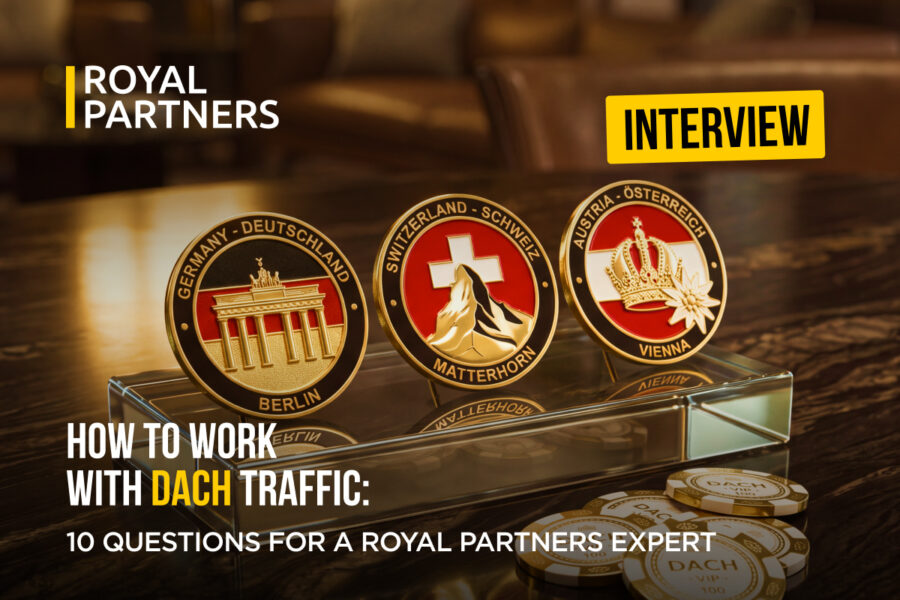
Royal Partners CBDO Alex discusses navigating the DACH affiliate market, covering player behaviour, regulatory challenges, and effective retention strategies.
Interview.- DACH is one of the most profitable yet challenging regions for affiliate marketers. On the one hand, it comes with fierce competition, strict regulation, and a demanding audience. On the other, it offers huge LTV potential and an audience with exceptionally strong spending power.
So, how can affiliates get the most out of this region, and where do they most often go wrong? Alex, CBDO at Royal Partners, shares their take.
Is there a difference in how you should approach Germany, Austria, and Switzerland?
The differences are significant, and much of it comes down to player expectations and market behaviour.
Take Germany. German players tend to be highly rational and trust-driven. They don’t convert on emotion alone. Before making a deposit, they may compare several reviews, study the terms, and leave if they encounter even the slightest lack of transparency during sign-up. In this market, facts, licensing, and security matter. When it comes to payments, players also tend to favour familiar methods such as SEPA, bank cards, Apple Pay, and Google Pay.
In Austria, the audience tends to be more flexible. Players are open to trying new products as long as the interface is clean and easy to understand. Promotions and localised messaging can work particularly well. And when it comes to payments, eps is a key method to support.
Switzerland, meanwhile, is all about premium service. Swiss players can deliver high player value, but they also expect the level of service to match. Any friction—from slow support responses to delayed withdrawals—can drive immediate drop-off.
What is the biggest pain point for affiliates trying to enter the DACH market?
Mistakes are expensive.
You’re not just competing with other media-buying teams. You’re competing with major local publishers and established national operators as well. Player acquisition costs can easily reach four figures.
There are also compliance costs, strict ad platform moderation, and tight creative restrictions to deal with. A standard funnel that works in another GEO may not work in DACH. Affiliates need proper testing, strong localisation, and an affiliate programme that can support them when issues come up.
What do affiliates look for in a product when choosing a DACH offer?
A high payout on its own doesn’t impress experienced affiliates anymore. They know how to run the numbers. A reasonable CPA on a product that converts well and has a smooth cashier flow can be much more valuable than a high payout on a weak brand.
They want to know what the product actually looks like in practice: Does the funnel convert? Does the cashier work smoothly? Are familiar local payment methods available? How long do withdrawals take?
If you want to pitch a DACH offer successfully, real conversion, retention, and LTV data matter much more than promises.
What about bonuses? Which mechanics work best for driving players to deposit?
There is no magic bonus mechanic. The most important thing is honesty and transparency.
German and Swiss players are particularly sensitive to anything that feels misleading. A simple offer—deposit this amount, get this bonus, and see the key wagering terms upfront—can work very well.
In general, fewer surprises in the terms mean less friction between registration and deposit.
Which commission model do affiliates in the region prefer: CPA, RevShare, or Hybrid?
It depends entirely on the affiliate’s business model.
SEO affiliates and content publishers understand the region’s LTV potential, so RevShare and Hybrid deals often make sense for them. They’re prepared to monetise players over a longer period.
Paid media teams have a different cost structure. Testing is expensive, and they need to recoup ad spend quickly, so CPA is often the preferred model.
We try to structure the commercial terms around the partner rather than push everyone into the same model.
Let’s talk about money. How important is payout speed in DACH—for both players and affiliates?
Very important—for both sides.
First, players. For them, a delayed withdrawal or a poorly communicated KYC process can damage trust very quickly. That affects retention and, in turn, the LTV the affiliate generates.
Second, affiliates themselves. DACH traffic is expensive and requires significant working capital. That’s why partners expect accurate reporting, quick issue resolution, and payouts on time.
If payments start arriving late, a partner can move traffic elsewhere very quickly, even if the CPA looked attractive on paper.
What makes an offer competitive in the region? Which brand advantages matter most to affiliates?
For me, it always comes down to the combination of CR + LTV. An experienced affiliate doesn’t just want to see an impressive number in a spy tool—they want actual bottom-line profit.
A slightly lower CPA on a product with excellent conversion and strong retention can generate far more revenue over time than an inflated payout on a brand where players churn after their first deposit.
Then comes the quality of the product itself, familiar local payment methods, and the strength of the affiliate team. Dedicated account management plays a huge role: fast operational support, transparent reporting, and the ability to negotiate custom terms are what keep major partners working with us for years.
Are DACH affiliates focused only on first-time deposits, or do they also care about retention?
Top DACH affiliates have been looking beyond the first-time deposit, or FTD, for a long time.
This is especially true for SEO affiliates, content publishers, and major media companies focused on long-term monetisation. Their key metrics include NGR, retention, and repeat deposits. They need a product that can keep players active for months, not just convert them once.
How many Royal Partners brands are currently available for DACH traffic?
We currently have 17 brands available for traffic from Germany, Austria, and Switzerland. The portfolio includes newer launches—IRIS, FUGU, BEEF, and MARTIN—as well as established brands such as FLAGMAN, IRWIN, GIZBO, LEX, 1GO, MONRO, DRIP, STARDA, LEGZO, IZZI, JET, SOL, and FRESH.
For affiliates, this means they can test different traffic sources, funnels, and brands across all three GEOs without having to work with several affiliate programmes.
Some brands also have elements designed with German-speaking audiences in mind. IRWIN is a good example. Its main character is a dog mascot. We’ve seen memorable characters and storytelling resonate with German-speaking players, and details like these can help create an emotional connection faster and move users toward their first deposit.
To wrap things up, what is the most overlooked challenge when working with partners in this market?
Again, mistakes are expensive.
One delayed payout, a tracking issue, or an unexpected change to agreed terms can seriously damage the relationship with a partner. And once that happens, it can be difficult to win the traffic back.
That’s why we put so much emphasis on transparency and consistency in DACH. Partners need to know what to expect from the product, the commercial terms, and the team supporting them. If they’re going to scale, they need confidence that those things won’t suddenly change.
Conclusion
DACH is a region where mistakes are expensive, but the right approach can deliver exceptional returns. Success in this market is not about testing random strategies and hoping something sticks.
Affiliates value transparent terms, strong localisation, a high-quality product, and complete predictability—both on the product side and in their relationship with the affiliate programme.
By Focus Gaming News Editorial Team