

Gevorg Tumanov on the future of igaming: Regulation, market entry and the new legal reality
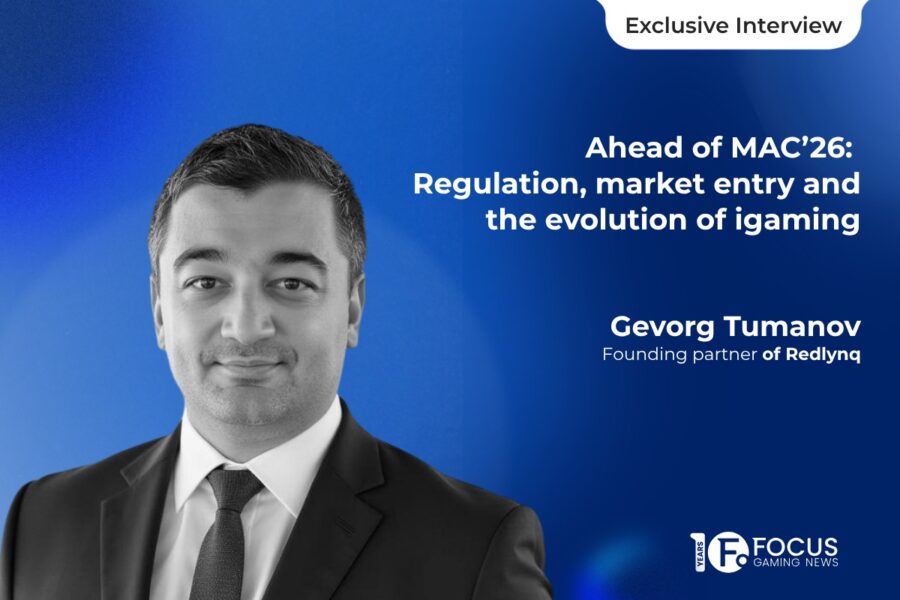
Gevorg Tumanov, Founding Partner of Redlynq, discusses global igaming evolution, regulatory trends, and legal architecture in this exclusive interview with Focus Gaming News ahead of the MAC’26 conference in Yerevan.
Exclusive interview.- From May 25 to 27, Yerevan will host iGaming & Affiliate Conference MAC’26 — the place where top Russian-speaking industry experts come together. One of them is Gevorg Tumanov, founding partner of Redlynq, an international consulting firm, with over 18 years of experience at the intersection of igaming, fintech, and international law.
In this exclusive interview, he shares his perspective on the evolution of global igaming, regulatory trends, and key advice for operators, marketers and newcomers who want to grow sustainably in an increasingly complex and secure environment. The conference will feature even more experts and valuable insights — a live continuation of the conversation you’ll read here.
What key trends are you seeing in global igaming today?
Igaming is becoming more mature, but also far more demanding. It is no longer enough to have traffic, a product and a licence. Increasingly, success depends on how well the business is structured – across payments, compliance, jurisdictional strategy and operational resilience.
Another defining trend is regulatory fragmentation. There is no longer a single model that works across all markets. Each jurisdiction now comes with its own expectations around advertising, affiliate models, KYC, payments and local presence.
And finally, infrastructure credibility matters more than ever. Banks, PSPs, investors and commercial partners are looking well beyond the brand itself. They want to see clear ownership, clean source of funds and credible internal controls.
“There is no longer a single model that works across all markets.”
Gevorg Tumanov, founding partner of Redlynq.
How do changes in legislation across different countries affect the strategy of operators and developers?
Directly. Today, no operator or supplier can build an igaming business on the basis of one structure for the whole world.
Changes in legislation affect almost everything: licensing, payment flows, marketing, affiliate strategy, target markets and even product mechanics. What is acceptable in one jurisdiction may be problematic in another.
You can see this clearly in Curaçao and the UK. In Curaçao, the focus has shifted towards ownership, AML/CFT, internal controls and the actual controllability of the business. In the UK, the emphasis is increasingly on customer protection, bonus design, affordability and marketing controls.
So the impact is not limited to the legal department. Legislation now shapes the business model itself.
What legal challenges do new projects face when entering the international market?
The biggest mistake is underestimating the complexity of international expansion. Many new projects assume that setting up a company, obtaining a licence and launching marketing is enough. In practice, it is not.
The first challenge is weak legal architecture. Very often, the licence, payment model, traffic geography, corporate structure and actual operating logic do not align.
The second is that regulatory risk now extends far beyond the licence. AML, advertising, affiliate traffic, data protection, sanctions, corporate substance and banking compliance are all part of the equation.
And there is a more practical issue as well: many lawyers approach these matters too formally. They understand the rule, but not always the business behind it. In international igaming, effective advice has to work both legally and commercially.
What should arbitrage specialists and marketers pay attention to in order to operate legally across different jurisdictions?
They need to understand that in igaming, marketing is no longer just a traffic function. In many jurisdictions, it is already a direct area of legal exposure.
It is not enough to look at creatives and conversion. The real questions are: who is being promoted, which audience is being targeted, what is being promised in the ad, whether the operator is entitled to target that market and whether local rules on gambling advertising and consumer protection are being observed.
I would pay particular attention to affiliate models. In many cases, the real risk does not come from the brand itself, but from how affiliates acquire users and how the journey to registration or deposit is designed.
“In igaming, marketing is no longer just a traffic function.”
Gevorg Tumanov, founding partner of Redlynq.
How do new regulatory restrictions affect igaming content and promotional materials?
Substantially. In today’s market, content is no longer just marketing – it is part of the regulatory perimeter.
In many jurisdictions, scrutiny now extends beyond direct gambling advertising to the tone and structure of the communication itself. Regulators are paying closer attention to aggressive bonus language, claims of easy winnings, urgency-based messaging, the use of vulnerable groups in visuals and influencer-led promotion.
That means promotional materials can no longer be assessed only from a design or conversion standpoint. They have to be both commercially effective and legally disciplined.
What mistakes do igaming start-ups most often make in complying with advertising and licensing laws?
The most common mistake is oversimplifying launch. Many start-ups assume that having a company, a website and some form of licence is enough. It rarely is.
The first mistake is a mismatch between the licence and the actual business model. The second is a careless approach to advertising, especially through affiliates, bonus claims, landing pages and influencer activity.
The third is trying to apply the same model across all markets. In igaming, that rarely works. The rules may look similar from a distance, but in practice they differ in ways that matter.
What are decentralised prediction market platforms, and how do they relate to igaming?
Prediction markets are platforms where users take positions on the outcome of an event and receive an economic result depending on whether that prediction is correct. In form, they may resemble event contracts or trading products, but in substance they are often very close to betting.
That is exactly why they are attracting so much attention. They sit at the intersection of igaming, trading and digital assets, and the key issue is not how the product describes itself, but how regulators choose to classify it.
It is also a genuinely promising segment. Unlike traditional igaming, where entry is becoming more difficult due to saturation and tighter regulation, prediction markets still offer a wider strategic opening. We are already advising on matters in this space and are seeing strong interest from global market participants.
If a project is fully decentralised, who bears legal responsibility: the developers, token holders or users?
The idea that a project is decentralised and therefore no one is responsible is legally risky. Regulators usually look beyond the label and focus on actual control.
They will ask who launched the product, who operates the interface, who changes the rules and who derives the economic benefit. In practice, legal exposure most often shifts towards developers, the core team and those who actively maintain or promote the project.
What legal risks arise when operating such platforms?
The main risk is uncertain legal characterisation. The same product may be treated in different jurisdictions as gambling, a financial instrument, derivatives activity, a payments-related service, or simply as an unlawful, unlicensed model.
That then leads to practical consequences: licensing issues, AML/KYC obligations, marketing restrictions, sanctions-related concerns, consumer-protection exposure, and liability risks for those behind the project.
These platforms may be highly promising, but entering the space without a clear legal assessment is a serious mistake.
Can quasi-gaming become a lawful alternative to traditional gambling for operators and marketers?
In some cases, yes. But only where it is genuinely a different product model, rather than a cosmetic repackaging of traditional gambling.
Quasi-gaming is interesting because it may sit between entertainment, competition, prediction mechanics, gamified engagement and digital products. That is why many see it as a more flexible and potentially scalable niche.
But legally, the same question always applies: what is the product in substance? If the mechanics and monetisation are too close to gambling, regulators are likely to treat it that way.
What legislative changes should the industry expect over the next one to two years, and how will they affect businesses?
The main trend is more granular regulation. Pressure will increase not only on licensing, but also on AML, ownership transparency, player protection, marketing controls, reporting and operational governance.
For businesses, this means something very simple: the winners will not be those who launch fastest, but those who build a sustainable legal and compliance model in advance. This is particularly relevant for grey-market operators, many of whom are now realising that they need new licences, transparent structures and a proper compliance framework.
That is also why interest in the US market is growing. It is complex and expensive, but it is also one of the clearest and most institutionally robust regulated markets.
What steps need to be taken to scale an igaming project globally while remaining compliant with the law?
The starting point should be structure, not traffic. First, a project must decide which markets it genuinely wants to enter. Then it needs to build the right licensing, corporate and payments architecture for those markets.
At the same time, compliance must be built in from the outset – AML, KYC, advertising controls, reporting and partner oversight.
Most importantly, the licence, product, marketing, traffic model and payment flows all need to align. Projects that scale successfully are not simply the fastest-moving ones, but the best-structured ones.
How do large international igaming platforms navigate legal restrictions without breaking the law?
Strong players do not “circumvent” restrictions in any simplistic sense. They structure their business with precision.
That usually means jurisdictional separation, the right licensing model, distinct payment logic, adapted marketing, local product restrictions and disciplined management of traffic sources and partners.
Their advantage is not that they ignore the rules, but that they understand much better where the line lies between a prohibited model and a permissible one.
Do you think fully global igaming regulation without national borders will ever become possible?
Probably not in a complete sense. Igaming is too closely linked to national law, taxation, consumer protection, AML and public policy.
That said, greater harmonisation is certainly coming. Approaches to compliance, ownership transparency, responsible gaming and advertising controls are likely to become more aligned as the market becomes more international and the risks more shared.
As Alfred Korzybski famously said, “The map is not the territory.” That is especially true in igaming. The global regulatory map may become clearer, but each jurisdiction will still remain its own territory, with its own logic and its own limits of what is acceptable.
Closing remark
The future of igaming belongs not to those who move the fastest, but to those who build most intelligently – with the right legal architecture, the right compliance culture and a model that can withstand scrutiny across borders.
By Focus Gaming News Editorial Team