



Eduardo Lobato, Sportradar: “The most important lesson was that global betting demand is neither monolithic nor linear”
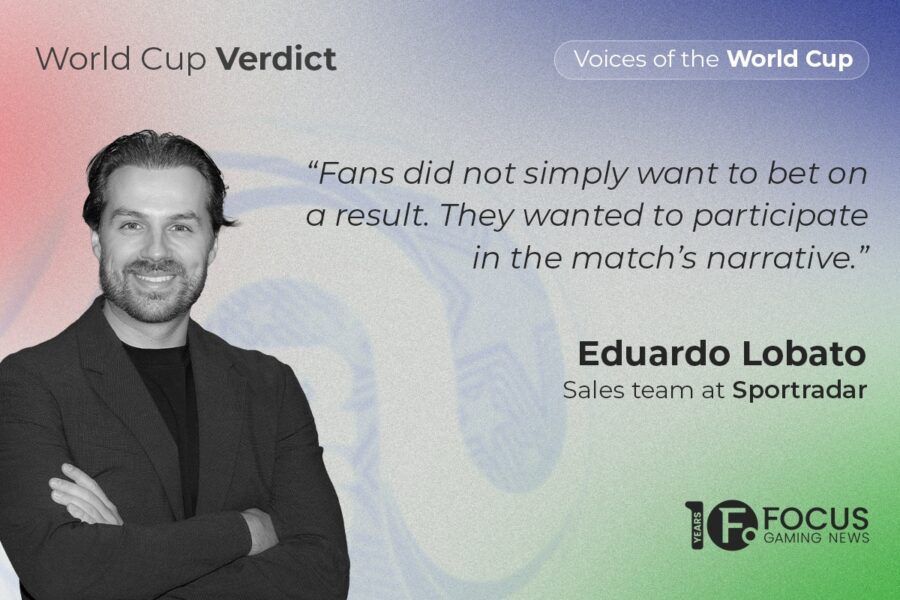

Focus Gaming News spoke to Eduardo Lobato, Enterprise Client Partner Lead at Sportradar, about the key takeaways from the 2026 World Cup.
Exclusive interview.- The 2026 FIFA World Cup was not only the biggest sporting event in the calendar; it was also a global proving ground for betting operators, affiliates, and technology providers, who were keen to understand how player behaviour changes under the pressure of a month-long tournament.
In the first instalment of “The World Cup Verdict”, a special content series exploring the lessons, data and industry insights from the FIFA World Cup 2026, Focus Gaming News spoke with Eduardo Lobato, enterprise client partner lead at Sportradar, to examine the tournament through the lens of data, technology and market performance.
Drawing on Sportradar’s insights across multiple regulated jurisdictions, Lobato reflects on the behavioural trends that defined the World Cup, the regional differences that challenged conventional approaches, and the innovations that helped operators respond to football’s biggest stage in real time.
Looking back at World Cup 2026, what was the single most important lesson you learnt about how football betting demand behaves on a global scale?
The most important lesson was that global betting demand is neither monolithic nor linear. It is fluid, omnichannel, and deeply influenced by emotion. Over a 39-day tournament, fan attention constantly shifts between matches, national teams, individual players, and unexpected storylines.
The true revelation was seeing that fans did not simply want to bet on a result. They wanted to participate in the match’s narrative through television, streaming, social media, and betting platforms. In a highly saturated advertising environment, success was therefore not determined solely by the size of the media investment, but by the ability to identify when attention and intent were at their peak, delivering a relevant message at that exact moment.
Which trend or market signal during the tournament surprised you most, either because it was stronger than expected or because it contradicted your pre-World Cup assumptions?
What stood out the most was the strength of in-play player markets and how much fan interest expanded beyond traditional match-winner and correct score betting. This was the first World Cup where the technology was available to collect and process the depth of data required to create these markets in real-time and at this scale.
The final was a strong example. Spain entered the match having conceded only one goal during the tournament, while Argentina had scored 19. Messi recorded eight goals and four assists, while Rodri, Aymeric Laporte, and Pau Cubarsí led the passing statistics. These contrasting profiles created narratives around goals, assists, passing, defensive actions, and other specific in-play player markets.
This also reflects a broader shift in sports fandom behaviour. Consumers are increasingly following individual athletes, not just teams, supported by the direct relationships players build with their audiences through social media. Contextual engagement was therefore particularly important: goals, penalties, momentum shifts, and individual performances created short but highly valuable activation windows.
Based on your analysis, which countries or segments behaved most unexpectedly during the World Cup, and what does that tell us about how demand really activates across markets?
One of the most unexpected patterns came from markets whose national teams were eliminated early in the tournament. The natural expectation would be a sharp decline in engagement. Instead, demand proved to be resilient and reconfigured around secondary narratives, including stars from other national teams, regional rivalries, and individual performance markets.
First-time bettors were another important segment. Before the tournament, it was expected that approximately 19 per cent of fans interested in betting would do so for the first time. Their participation demonstrated that a major event can generate a significant acquisition wave, but registration alone does not automatically translate into long-term customer value. The quality of onboarding, payment simplicity, relevant recommendations, and continuous communication are the defining factors of whether this initial interest will develop into a lasting relationship.
The broader lesson is that demand is more elastic than previously assumed. It can migrate from national teams to individual athletes, rivalries, and emerging tournament narratives when operators have the technological agility to adapt their markets, content, and communications.
In terms of geo-specific configuration, which markets forced you to adapt your World Cup experience most sharply, and what did you learn from those differences?
Brazil required the most significant and sophisticated adaptation in Latin America. Since this was the country’s first World Cup under a fully established betting regulatory framework, the challenge was no longer simply to maximise visibility. Operators also needed to prioritise efficiency, compliance, and relevance throughout the entire customer journey.
The adaptation went far beyond integrating local payment methods like PIX. It required precise audience segmentation, messaging aligned with regulatory requirements, and the ability to activate campaigns through contextual triggers. Solutions like Sports Moments Marketing were particularly important because they allowed operators to respond to live match events with creative, relevant, and timely assets, rather than relying on generic, pre-planned promotions.
The United States provided a different lesson. Operator clients reported that World Cup betting activity exceeded their expectations, supported by the national team’s strong performance and its progression to the knockout stage. This generated significant patriotic engagement and demonstrated how sporting performance can accelerate interest in football within a market where the sport traditionally competes with several major domestic leagues.
In other Latin American markets at an earlier stage of regulatory development, a greater emphasis on consumer education, transparency, and trust was necessary. The overall lesson was that a “one-size-fits-all” strategy is no longer viable: configuration must reflect consumer maturity, the regulatory environment, local payment habits, and the position of football within each market.
What new metrics, visualisations or tools proved most valuable for clients during the tournament, and which ones turned out to be less useful than expected once real traffic hit?
The most valuable tools were the real-time analytics dashboards that connected live match events with campaign and betting-ticket performance. Instead of focusing solely on overall CPA, clients were able to evaluate registrations, first-time deposits, conversion rates, deposit values, and betting-ticket activity broken down by match, creative, player market, and audience segment.
Tools like Sports Moments, FanID, and Sportradar’s proprietary DSP also supported automated triggers, personalisation, and real-time budget optimisation. In contrast, static pre-tournament demographic models and broad-reach metrics became less useful as soon as fan attention began shifting among matches, players, and live narratives. Age and gender remained relevant, but behavioural signals, such as the team, the player, or the match event that had recently captured a user’s attention, proved to be much more actionable.
Which retention mechanics (bonuses, tournaments, loyalty, segmentation, triggers) clearly reduced post-World Cup churn, and which had less impact than expected?
The retention mechanics that most clearly reduced post-World Cup churn were behavioural segmentation and personalised triggers. For example, a fan who consistently bet on England and Harry Kane could receive tailored offers linked to the Premier League and the Bundesliga immediately following the tournament. This type of narrative continuity, enabled by tools like FanID and AI-driven recommendations, provided a relevant reason for the user to remain engaged beyond the World Cup.
The strength of player markets reinforced this opportunity. Countless betting tickets during the tournament were connected to player markets, demonstrating that many fans were following individual athletes as much as national teams. Therefore, these behavioural signals could be used to connect clients with the next relevant club competition, a specific player’s narrative, or a domestic league.
Broad and non-segmented deposit bonuses had less impact. While they could support short-term acquisition, they often failed to build upon the emotional connection created during the tournament. The main lesson was that retention must be designed from the acquisition phase, utilising behavioural data to identify each customer’s interests and smartly connecting them to the next sporting narrative.
If you had to choose one decision during the World Cup that you would repeat, and one you would not, what would they be and why?
I would repeat the investment in AI-powered, real-time contextual marketing, maintaining flexibility between brand and performance budgets. In a 39-day tournament, unexpected results and constantly evolving fan narratives can rapidly shift betting attention and
intent. Therefore, dynamically reallocating investment to the best-performing channels, audiences, and storylines proved to be much more effective than sticking to a rigid media plan.
What I would approach differently is the allocation of resources between front-loaded acquisition, retention, and granular in-play markets. The opening phase naturally generates registrations, but acquisition volume alone does not create long-term value without personalised communication and a clear post-tournament journey.
For future major events, brand building, acquisition, retention, and in-play product development should be treated as one continuous, adaptable strategy, rather than separate stages of the business.
This is the first instalment of The World Cup Verdict, a special content series exploring the lessons, data and industry insights from FIFA World Cup 2026. Over the coming days, Focus Gaming News will publish interviews with key industry leaders and a Blask data analysis revealing what the tournament really meant for global betting demand.
Follow the series at focusgn.com.
By Focus Gaming News Editorial Team