

Anton Eshtokin, Boomerang Partners: “The main drivers for 2026 are the high concentration of key sporting events and the growing interest in live betting and esports betting”
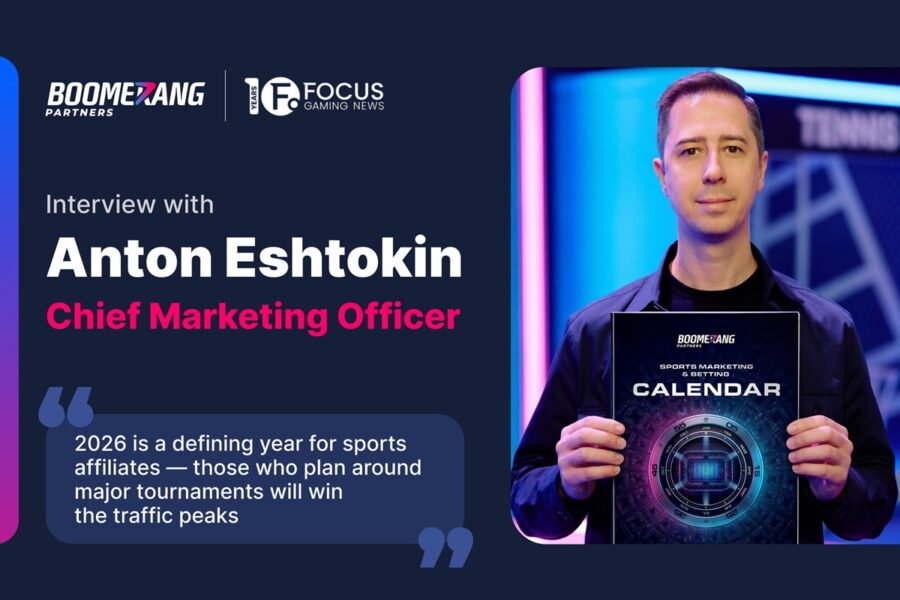
Boomerang Partners CMO spoke with Focus Gaming News about the strategic importance of the 2026 sports calendar and how affiliates can leverage the AC Milan partnership to maximise player engagement.
Exclusive interview.- As the sports and online betting landscape prepares for an exceptionally dense and high-impact calendar in 2026, affiliates are facing both heightened competition and unprecedented opportunity. In this exclusive interview with Focus Gaming News, Anton Eshtokin, chief marketing officer at Boomerang Partners, explains why the year ahead is particularly strategic for sports-focused affiliates and how data-driven planning will be essential to success.
From leveraging global events such as the FIFA World Cup 2026 and the Milano Cortina Winter Olympics, to understanding shifting player behaviour, traffic peaks, and cross-sport migration, Eshtokin outlines how Boomerang’s Sports Marketing & Betting Calendar 2026 is designed to help partners anticipate demand and optimise campaigns. He also discusses the role of AI, advanced analytics, GEO and device segmentation, and the commercial value of Boomerang’s partnership with AC Milan in driving stronger engagement, retention, and long-term monetisation.
2026 is being described as a defining year for sports and online betting. From your perspective, which dynamics make 2026 particularly strategic for sports affiliates, and how does the Sports Marketing & Betting Calendar help them anticipate and capitalise on these opportunities?
In my view, the main drivers for 2026 are the high concentration of key sporting events and the growing interest in live betting and esports betting. Major global tournaments, such as the FIFA World Cup 2026, which traditionally attract a massive audience, and the Olympic Winter Games Milano Cortina 2026, are particularly significant. These top-tier competitions create unique opportunities for user engagement. With proper campaign planning, affiliate partners can significantly boost conversions and expand audience reach.
Our ‘Sports Marketing & Betting Calendar 2026’ delivers practical value for sports-focused affiliate partners. It brings together our analysts’ insights, the competition calendar, traffic peak information, and a toolkit for campaign planning. Additionally, the guide features information about Boomerang’s partnership with AC Milan and how it can be used to create relevant sports content and promotional activities. All of this allows affiliates focused on sports verticals to plan strategies in advance, quickly adapt to changing audience interests, and align with major sporting events to run effective, high-yield campaigns.
“Our ‘Sports Marketing & Betting Calendar 2026’ delivers practical value for sports-focused affiliate partners.”
Anton Eshtokin, chief marketing officer at Boomerang Partners.
Your guide includes deep analytics on player behaviour before, during, and after major tournaments. What are the most important behavioural patterns affiliates should be prepared for in 2026, and how can they use these insights to avoid missing key traffic peaks?
It’s essential to understand that player behaviour undergoes significant changes at each stage of a major tournament. So, before the start, activity builds gradually and accelerates sharply in the days leading up to the first match. During this period, the number of registrations and first deposits grows, but the bets themselves remain more measured: players choose favourites, national teams, and long-term outcomes. Timing is crucial here — those affiliate partners who start warming up the audience too late often miss the early, highest-quality interest.
During the tournament, the logic changes. Live betting takes centre stage, sessions become shorter but more frequent, and decisions are made emotionally and in the moment. Traffic peaks occur during goals, key moments, and decisive matches, especially in the playoffs. After the final, the activity doesn’t disappear but scatters: the mass audience takes a pause, while more experienced players switch to other sports or secondary competitions. Therefore, those affiliates who plan this transition in advance and redirect traffic, without waiting for interest to wane, can avoid sharp declines and maintain stable monetisation.
“Player behaviour undergoes significant changes at each stage of a major tournament.”
Anton Eshtokin, chief marketing officer at Boomerang Partners.
Boomerang Partners highlights the relevance of guiding player migration between sports, for example, moving football fans into tennis post-tournament. What practical steps can affiliates take to manage this transition effectively and maintain engagement throughout the year?
In practice, this is primarily a matter of preparation, not reacting after the fact. Affiliate teams must expand the players’ horizons even before the end of a major football tournament. How? – By introducing the audience to other active sports, showing the calendar of upcoming events (they can use our guide for this purpose), and explaining where and why there is interest now. When the user already understands that the season doesn’t end with the final match, the transition happens more smoothly and without losing interest.
The second key point is presentation and context. Migration works better when the new sport is logically connected to the player’s habitual behaviour: dynamics, event frequency, and betting format. The same tennis works well for football audiences due to constant live play and quick matches. Affiliates should use simple entry points – educational materials, match compilations “for today,” emphasis on understandable online betting markets, and live scenarios. This approach allows maintaining activity throughout the year and not depending exclusively on one sports tournament.
When planning campaigns, what should affiliates keep in mind regarding GEO, device type, and traffic source segmentation?
Geographical region defines both user intent and behaviour. Different markets respond to different sports narratives, online betting habits, and trust signals. What works in one market may fall flat in another, so localisation should shape everything – from the sports focus and timing to the language, visuals, and promotional angle.
Device type and traffic source set the pace of the campaign. Most users arrive from mobile devices, which means that fast-loading pages, simple flows, and clear calls to action are non-negotiable. Traffic source matters just as much: search traffic expects structure and analysis, while social and content-driven traffic reacts to visuals, emotion, and live context. Affiliate partners who respect these differences build campaigns that feel natural to the user – and perform better as a result.
Your partnership with AC Milan appears to be a central pillar of your strategy. How can affiliates leverage this collaboration (exclusive content, brand credibility, and fan engagement) to achieve stronger retention, better CTR, and higher monetisation?
AC Milan is a powerful asset not only because it’s a global brand, but because it gives our affiliate partners access to relevance, credibility, and attention at scale.
First, we have access to official content and can use it in our marketing initiatives in coordination with the Club, which we do on a regular basis. This instantly elevates creatives – ads, landing pages, and social content perform better when they feature recognisable players, matchday visuals, and authentic Club imagery. Higher visual trust translates directly into stronger CTR and deeper session depth.
Second, AC Milan adds brand authority. When users see an affiliate program connected to a globally recognised football Club, hesitation drops. This is especially important in competitive markets, where trust is often the deciding factor between a click and a bounce, or between a registration and a first deposit.
Third, the partnership enables fan-driven engagement, rather than generic online betting promotions. AC Milan’s fan base (which numbers over 550 million people) follows narratives – derbies, key fixtures, player performances, and historic rivalries. Affiliate partners who align their content with these moments naturally achieve better retention, because users return not just to bet, but to follow the story.
Finally, monetisation improves when campaigns move from “one-off offers” to season-long activation. Using AC Milan as a recurring context – from pre-match build-ups to post-match analysis and special campaigns – allows affiliates to extend player lifetime value rather than chasing short-term spikes.
The guide notes that 44 per cent of affiliate content is already optimised with AI. What technological trends (AI, data modelling, behavioural analytics) do you believe will have the greatest impact on affiliate performance in 2026, and how is Boomerang supporting partners in this transformation?
I agree with the trends mentioned. And it’s hard not to agree that the influence of AI is growing every year. It allows adapting content for specific audiences and predicting which campaigns will be the most effective. At the same time, it’s important to understand that AI is a tool to support humans, not a cure-all: blindly relying on algorithms is not possible; decisions always require expert evaluation. As for behavioural analytics and data models, they help identify key conversion drivers and optimise strategies based on real data, not intuition.
We support our affiliate partners through our powerful in-house analytics department, with rich sports expertise. Our analysts provide quick and high-quality insights, offering deep immersion in nuances, which enables partners to adapt strategies and scale campaigns effectively. Additionally, our affiliate managers provide 24/7 support. This helps to maximise the possibilities of data and technologies.
By Focus Gaming News Editorial Team