Anti-fraud trends and best practices: Frogo
In the following article, Volodymyr Todurov, CEO of Frogo, explains how to combat fraud in an increasingly complex digital ecosystem.
Opinion.- Fraud has evolved. It’s no longer limited to opportunistic scams – today, it’s a scalable, well-organised operation fueled by automation, social engineering, and increasingly, AI. In industries like igaming, payments, and e-commerce, fraudsters move fast. To stay ahead, companies need more than rules or reactive tools – they need precision, adaptability, and visibility.
The fraud prevention landscape is shifting. As digital ecosystems grow more complex, the “one-size-fits-all” detection model is fading. Businesses are seeking platforms that are not just comprehensive but deeply customisable – solutions that grow with them and adapt to ever-changing threats.
“We’re not just chasing fraud – we’re predicting and preventing it before it begins. Our goal is to empower companies to see fraud not as an inevitable loss, but as a solvable challenge.”
Volodymyr Todurov, CEO at Frogo.
From tactical to strategic: the shift in anti-fraud mindsets
Legacy fraud tools are built to react: detect fraud, block it, and move on. That worked – until fraud tactics became too fast and too dynamic. Now, we’re seeing a clear shift toward AI-driven, proactive systems that don’t just track what’s happening, but uncover why it’s happening.
Take igaming. So-called illegal bonus abuse is no longer a fringe case – it’s a significant profitability risk. Combatting it means analysing user behaviour in real-time: how players register, how they play, and how they interact across multiple accounts or devices. The same principle applies to payment fraud or e-commerce return scams – contextual behaviour matters as much as the transaction itself.
AI and graph analytics: the new backbone of risk intelligence
The integration of AI and graph-based forensic tools is transforming how we fight fraud. AI models trained on historical and contextual data identify subtle anomalies that conventional systems miss. Graph analytics takes this further by mapping relationships between accounts, IPs, and transactions – making complex fraud patterns visible and traceable.
“With graph analytics, fraud stops being invisible. In seconds, we turn suspicious dots into connected, actionable stories.”
Volodymyr Todurov, CEO at Frogo.
This is especially powerful for uncovering fraud rings, CPA manipulation, and multi-accounting schemes. What used to take hours to trace manually can now be surfaced in a few clicks.
Fighting false positives with dynamic scoring
False positives are more than just an annoyance – they’re a major source of lost revenue and trust. Every legitimate customer blocked is a lost revenue. Frogo tackles this with dynamic scoring: a system that adapts based on context, historical behavior and real-time inputs.
Unlike rigid yes/no rules, dynamic scoring evaluates each case as a living signal – minimising disruption for good users while staying alert to risk. For high-volume sectors like trading platforms or dating services, this precision reduces friction and improves user retention.
“False positives cost businesses more than fraud itself – up to 3 per cent of annual revenue, according to industry benchmarks. With Frogo’s dynamic scoring engine, our partners have significantly reduced false positive rates, automating the money-out procedure up to 98.5 per cent for the regular player cohort, while limiting manual checks to just 0.2 per cent for the VIP cohort. That’s not just accuracy – it’s recovered revenue, protected reputation and stronger loyalty.”
Volodymyr Todurov, CEO at Frogo.
Real-time alerts and messenger integration: speed is strategy
Detection is only useful if it triggers action. Fraud alerts hidden in dashboards don’t stop losses. That’s why Frogo integrates with messenger platforms, email and team workflows – delivering real-time alerts that are visual, audio and immediately actionable.
In fraud prevention, speed isn’t a bonus – it’s a necessity. Rapid signal-to-response time defines whether an anomaly turns into an incident.
Scalable rule management and smart lists: stay ahead of the curve
Fraud evolves rapidly – and your rules should be able to adapt just as quickly. With Frogo, creating or adjusting a rule is a matter of a few clicks. There’s no need to involve developers, write custom code, or wait for production deployments.
Many of our partners previously faced significant friction when updating risk logic – often requiring development of new features and full release cycles just to respond to emerging threats. Frogo eliminates that complexity.
Our platform empowers risk teams to act in real time, without operational bottlenecks. Automated list management further enhances efficiency by ensuring blacklists and whitelists remain current and effective, while minimising manual effort.
The result is a more agile fraud strategy – one that enables teams to stay focused on prevention and innovation, rather than routine maintenance.
Consulting and expertise: building fraud resilience from the ground up
Technology alone won’t stop fraud. That’s why we work with clients not just as a platform, but as a partner. Frogo helps businesses build strong internal processes, train teams and develop a risk-aware culture.
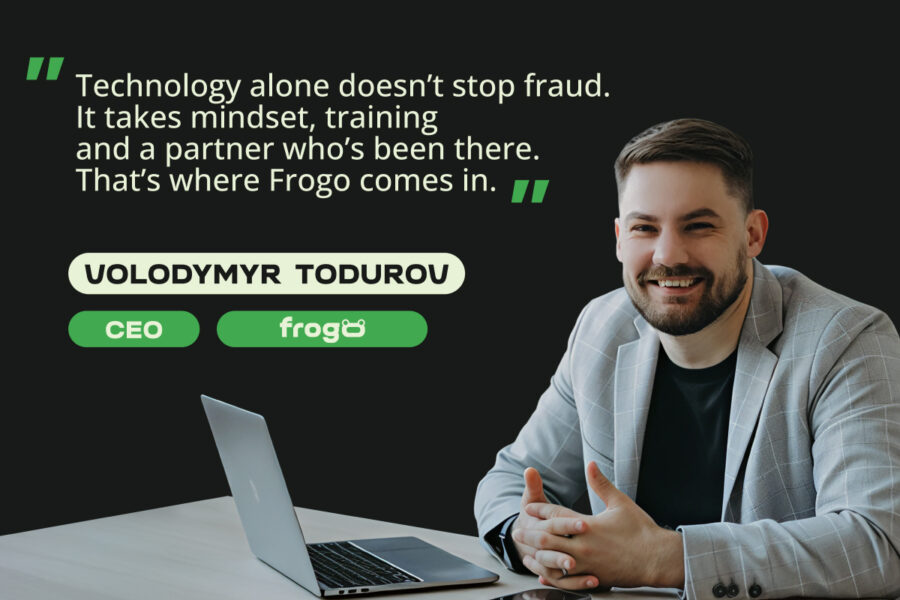
“Technology alone doesn’t stop fraud. It takes mindset, training and a partner who’s been there. That’s where Frogo comes in.”
Volodymyr Todurov, CEO at Frogo.
Looking ahead: the future of fraud prevention
Fraudsters are getting faster, smarter and more automated. To keep up, fraud prevention needs to be just as intelligent and integrated. The future belongs to platforms that aren’t siloed but deeply embedded into every layer of the business.
The tools exist. The expertise is here. The question is: will you act before the next wave hits?
By Focus Gaming News Editorial Team