


Alexandre Tomic, Alea: “Aggregation has to become broader than games”
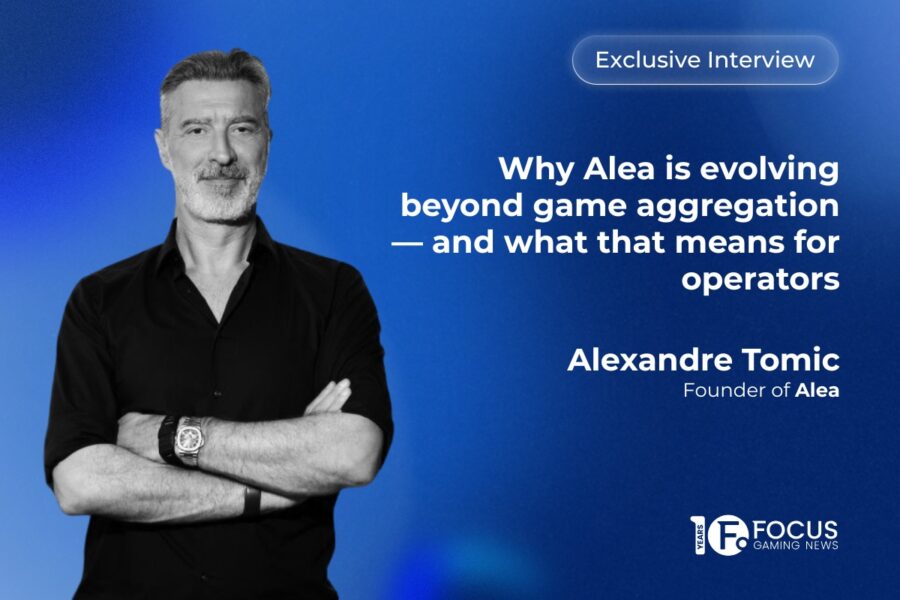
At SBC Summit Lisbon, Alea is showcasing its expansion beyond gaming aggregation.
Key takeaways:
- Alea is expanding beyond game aggregation into payments, jackpots and sportsbook.
- Brazil remains one of Alea’s key markets, despite higher taxes, marketing costs and compliance requirements.
- Alexandre Tomic says operators cannot apply European strategies directly to Brazil, where player behaviour and market trends change rapidly.
- Alea launched its sportsbook vertical with FIRST.bet and is now focused on bringing the solution to operators.
- The company will also expand its Jackpot offering and showcase its products at SBC Summit Lisbon and SiGMA Rome.
Exclusive interview.- Alea is expanding its aggregation model beyond games as it targets new opportunities in Brazil and other emerging markets, with payments, jackpots and sportsbook now part of its offering. In an exclusive interview with Focus Gaming News, ahead of SBC Summit Lisbon, founder Alexandre Tomic said Brazil remains a key market for the company despite rising taxes, acquisition costs and regulatory demands, while stressing that its next phase will require a deeper understanding of local player behaviour and economics. [Editor’s note: this interview took place before President Lula’s announcement banning online betting in Brazil, made last Friday.]
Alea is attending SBC Summit Lisbon following a very busy first half of the year. What sort of presence will you have in Lisbon, and what are the company’s main objectives in terms of brand visibility and business generation?
Lisbon brings together Europe, LatAm, and increasingly sweepstakes, so for us there is a lot happening in one place.
On September 30 at 11:40am, I’ll be doing a solo presentation on the Global & Emerging Markets Stage, Beyond the Hype: What the Data Really Says About Sweepstakes. Then at 2pm, Jordi and I will be doing the press conference The Sweepstakes Phenomenon: The Data Reshaping Online Casino.
On October 1 at 11am, I’ll be joining the panel Copycat Culture: Branding Beyond Visual Identity on the Tech Stage. And at 12pm, Jordi Sendra, our CEO, will be speaking on Brazil Unfiltered: What Leaders Actually Think.
At the booth, we’ll also have Luck Decoded every day at 4pm. It’s a daily giveaway with an element of luck, but there will also be something that can change the outcome. We’ll reveal exactly how it works on the day.
On the product side, we’ll continue showing the Alea Jackpot and doing demos with operators, and we’ll also be presenting the sportsbook solution we’re launching with FIRST.
It’s a busy few days, but that’s the point. A lot of our clients, providers and people we’ve known for years will all be there, so we want to show what we’ve been working on and spend time with them while everyone is in the same place.
Alea started as a game aggregator, but the ecosystem now includes payments, the Jackpot and sportsbook. How is your vision of aggregation evolving beyond games?
Aggregation is still at the core of what we do, but over time we realised that operators need much more than access to games.
We sit between operators and providers, and that is not always the most comfortable position. If an operator becomes big enough, they can go direct with a studio. If a studio becomes big enough, they also want that direct relationship. So we have to keep asking ourselves why they should continue working with us.
For me, the answer is that aggregation has to become broader than games.
That’s why we launched Alea Pay. The Jackpot came from something our operators were asking us for, and sportsbook is the same. They wanted it, so we looked at how we could offer it properly, and FIRST.bet had the expertise and the quality we were looking for.
So we are still aggregating. We are just applying that same logic to more parts of the operator’s business.
The panel “Brazil Unfiltered: What Leaders Actually Think” promises an unfiltered look at what has worked and what hasn’t in the first year of regulation in the country, against a backdrop of increased tax pressure and rising marketing costs. What is your assessment of the Brazilian market today?
Brazil is one of the most exciting markets in the industry, but it has become much more demanding.
The beginning of regulation was difficult. There was a lot happening at the same time: certification, taxation, new operational requirements, higher acquisition costs. Everybody had to adapt very quickly. Since then, the market has recovered strongly, but the first year has shown how much preparation this market requires.
I also think we are very early in the process. Regulation is going to keep evolving, the economics will keep changing, and operators are learning what works and what doesn’t in this new reality.
For us, Brazil remains one of our most important markets. It is huge, there is so much that is going to happen there, and I don’t think we are anywhere close to seeing its final shape yet.
What would you say characterises the Brazilian market today, and what mistakes must not be repeated in the next phase of growth?
Brazil moves incredibly fast. Player behaviour changes quickly, trends appear from nowhere, and something that works for six months can look completely different six months later. Fortune Tiger is probably the best example of that. Nobody sitting in Europe could have predicted what that game was going to become in Brazil.
So the biggest mistake is thinking you can understand Brazil from outside Brazil. You cannot take a European strategy, translate it into Portuguese, and expect it to work. You need Brazilian people, you need the data, and you need to be close enough to the market to understand what is actually happening.
The other mistake is thinking the size of the market makes everything easier. Brazil is a very big market, but you still need to be extremely efficient. With taxes, marketing costs and compliance, you need to know exactly where your money is going and what is actually working.
There is a lot of opportunity there, but you have to understand Brazil on its own terms.
“The biggest mistake is thinking you can understand Brazil from outside Brazil. You cannot take a European strategy, translate it into Portuguese, and expect it to work.”
Alexandre Tomic, founder of Alea.
What are Alea’s key strategic priorities for the second half of the year?
Sportsbook is the big focus. We’ve recently launched the vertical with FIRST.bet, so now it’s about getting it in front of operators and seeing how they use it.
We’ll also keep pushing the Jackpot, with more demos and a broader rollout.
And then we have SiGMA Rome, which is the next major event for us before the end of the year.
“Sportsbook is the big focus. We’ll also keep pushing the Jackpot, with more demos and a broader rollout.”
Alexandre Tomic, founder of Alea.