Uganda casinos propose 30% GGR alternative to 15% tax
The association says chip-based transactions make player-level tax calculations difficult and is calling for separate licensing and stronger oversight.
Key takeaways:
- Uganda’s casino operators want land-based casinos to remain under the 30 per cent gross gaming revenue (GGR) tax framework instead of the 15 per cent withholding tax on player winnings.
- UGOA says calculating individual winnings is complicated because customers buy, use and redeem chips across multiple games.
- The association estimates that licensed land-based casinos directly employ more than 2,500 people.
- Uganda’s Income Tax (Amendment) Act, 2026 introduced a 15 per cent withholding tax on gaming and betting winnings from July 1, 2026, exempting only winnings paid by a licensed national lottery operator.
- UGOA is calling for separate licensing, clearer transaction classifications, independent audits and stronger monitoring to address compliance concerns.
Uganda. Uganda’s land-based casino operators are challenging the 15 per cent withholding tax on gaming winnings, proposing that they remain under the existing 30 per cent gross gaming revenue (GGR) framework. The Uganda Gaming Operators Association (UGOA) argues that calculating individual player winnings creates operational difficulties and increases compliance costs. The association says the tax could also put more than 2,500 jobs at risk.
The concerns follow an engagement between gaming industry stakeholders and the Private Sector Foundation Uganda (PSFU), led by its executive director, Stephen Asiimwe. PSFU’s Policy Department is expected to assess the taxation challenges and their implications for employment, business sustainability and livelihoods before preparing an advocacy paper, according to UG Standard.
UGOA chairman Robert Kabonero said the association wanted a tax collection approach suited to land-based casinos. “We are not opposed to taxation, and as licensed operators, we pay our fair share. What we are asking for is a practical and fair collection approach that reflects how land-based casinos operate,” Kabonero said.
The association argues that calculating individual winnings in physical casinos is more complicated than tracking transactions through online player accounts. Customers may purchase chips, move between games and redeem their remaining chips at the end of a visit, making it difficult to establish their overall net position.
UGOA illustrated the issue with a player who buys UGX1m (US$245) in chips but cashes out UGX700,000 (US$171). The player has recorded a net loss of UGX300,000 (US$73), rather than a winning amount on which withholding tax should be charged, the association argues.
UGOA proposes alternative compliance measures
To address these concerns, UGOA proposes separate licensing for online and land-based casinos, clearer transaction classifications, separate financial records, independent audits and stronger monitoring. It says implementing the tax would otherwise require additional player identification, transaction monitoring and reconciliation processes.
The association estimates that licensed land-based casinos directly employ more than 2,500 people. It warns that higher compliance costs could affect operators, employees and local suppliers, while encouraging some customers to turn to illegal gambling channels.
Kabonero said the existing 30 per cent GGR framework, calculated on the difference between total wagers and winnings paid out, would provide a more reliable way for the government to collect revenue if supported by stronger oversight and enforcement.
The tax is provided for under the Income Tax (Amendment) Act, 2026 (Act 21 of 2026), which was assented to on August 20 and gazetted on August 28. The legislation took effect retrospectively from July 1, 2026, and sets withholding tax at 15 per cent of gaming and betting winnings, defined as the difference between the pay-out and the amount staked.
Uganda’s gambling regulator had previously engaged operators on the implementation of the new withholding tax, including how player winnings should be calculated.
Parliament removed a proposed exemption for winnings from land-based casinos on August 4, retaining an exemption only for winnings paid by a licensed national lottery operator. Parliament said the proposed casino exemption could create opportunities for tax avoidance and revenue leakage.
The Uganda Revenue Authority (URA) clarified how the tax must be applied in its public notice, “Withholding Tax on Payments for Winnings of Gaming or Betting”, first published on October 30 and updated on November 2, 2026.
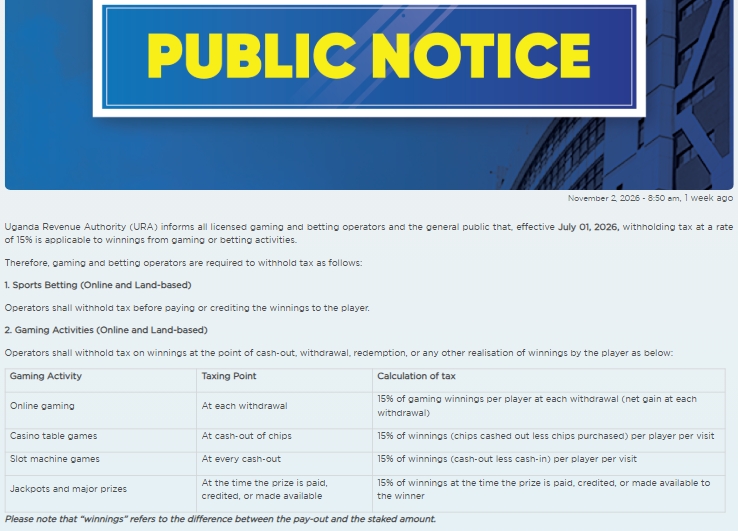
The notice specifies that casino table-game winnings are calculated as chips cashed out less chips purchased by each player during a visit. For slot machines, the calculation is cash-out less cash-in. Online gaming winnings are subject to 15 per cent withholding on net gains at each withdrawal, while sports betting operators must withhold the tax before paying or crediting winnings.
URA also requires licensed operators to disclose withholding tax on player receipts or transaction records, display notices informing customers about the tax, retain records for five years and submit monthly Gaming Information Returns detailing player transactions.
UGOA is seeking further consultations with government and industry stakeholders, as well as a joint technical working group to examine the collection challenges and recommend a workable approach. The association is seeking changes to how the tax applies to land-based casinos, while the current law continues to require a 15 per cent withholding tax on gaming winnings.
Frequently asked questions (FAQs)
- Why are Uganda’s casino operators challenging the 15 per cent withholding tax? UGOA says calculating individual winnings in land-based casinos is complicated because players buy and redeem chips across multiple games. It argues that the requirements could increase compliance costs and make tax collection more difficult.
- What tax do Uganda’s casino operators want to retain? UGOA wants land-based casinos to remain under the existing 30 per cent gross gaming revenue (GGR) tax framework instead of the 15 per cent withholding tax on player winnings.
- How does Uganda calculate casino winnings for withholding tax? According to URA, table-game winnings are calculated as chips cashed out minus chips purchased during a player’s visit. For slot machines, the calculation is cash-out minus cash-in.
- When did Uganda’s 15 per cent gaming winnings tax take effect? The Income Tax (Amendment) Act, 2026 took effect retrospectively from July 1, 2026. It applies to gaming and betting winnings, with an exemption for winnings paid by a licensed national lottery operator.