Garron Whitesman: “Treasury is barking up the wrong tree”
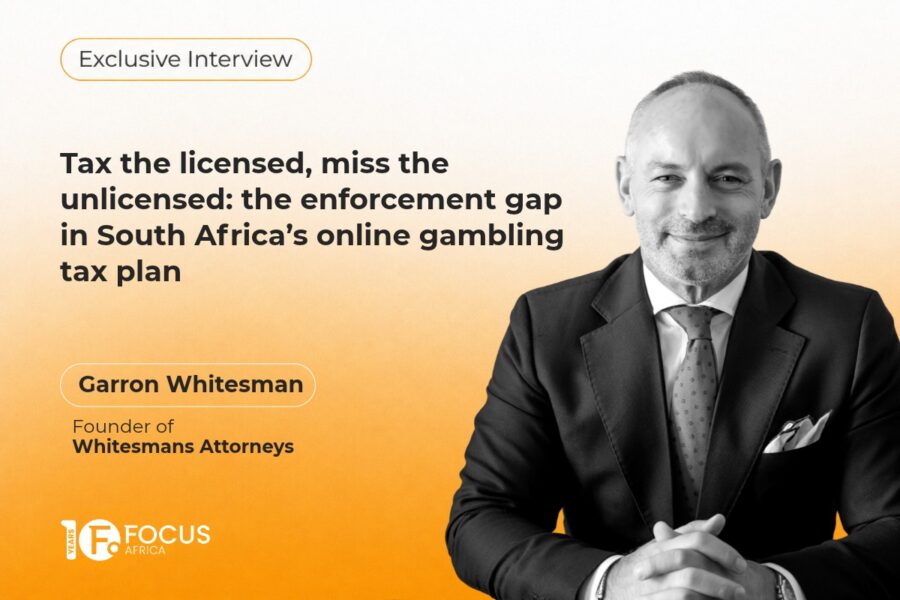

The founder of Whitesmans Attorneys says there is no evidence South Africa’s proposed 20 per cent online gambling tax will curb problem gambling, and expects its legality to be tested in court.
Key takeaways:
- Garron Whitesman, founder of Whitesmans Attorneys, said he would not consider any national gambling tax rate fair, appropriate or legal, as provinces have taxed operators’ GGR for the past 30 years.
- He estimates the proposed 20 per cent national tax could take the combined effective tax burden on licensed online betting operators to 38–39 per cent of GGR, including provincial taxes and VAT.
- Whitesman said whether national government can impose the tax is a vexed issue that will more likely than not end up in South Africa’s superior courts.
- His submission to National Treasury warned of job losses, channelisation to the black market and erosion of the tax base, and he said Treasury has not addressed these concerns.
- He said there is no evidence the tax will reduce problem gambling, which Treasury describes as its main objective.
Garron Whitesman, founder of Whitesmans Attorneys, has argued that South Africa’s national government cannot lawfully impose its proposed 20 per cent tax on online betting GGR, an issue he expects to end up in the country’s superior courts. He said the tax would not achieve Treasury’s stated objectives of raising revenue and mitigating problem gambling, warning of job losses and channelisation to the black market. He added that enforcing it against offshore operators would be unfeasible.
Exclusive interview.- South Africa’s proposed 20 per cent national tax on online gambling gross gaming revenue (GGR) has raised questions about its potential impact on licensed operators, government revenue and the competitiveness of the regulated market. With provincial gambling taxes and VAT already in place, the additional levy could bring the combined effective tax burden on licensed online betting operators to approximately 38–39 per cent of GGR, according to legal estimates.
The proposal, which National Treasury has presented as a measure primarily aimed at discouraging problem gambling, has also prompted concerns over its legal basis, the potential migration of players to unregulated offshore platforms and the practical difficulties of collecting taxes from operators outside South Africa. Critics argue that these issues could undermine both the government’s revenue expectations and its consumer-protection objectives.
In this exclusive interview with Focus Gaming News, Garron Whitesman, founder of Whitesmans Attorneys, challenges the legal basis for introducing a national gambling tax and examines its potential consequences for employment, tax revenue and the wider industry. He also discusses the enforcement challenges posed by offshore operators, the distinction between online betting and interactive gambling under South African law, and why he believes National Treasury has yet to demonstrate that the proposed levy would reduce gambling-related harm.
You have raised concerns about the proposed 20 per cent national online gambling tax, estimating that it could take the combined effective tax burden on licensed online betting operators to 38–39 per cent of GGR, including provincial gambling taxes and VAT. What national tax rate would you consider fair, and why?
I would not consider any national tax rate as fair, appropriate or legal. The provinces have taxed gambling activities based on operators’ gross gambling revenue for the past 30 years. National government has collected VAT, corporate and withholding taxes on gambling licensees’ activities during that period. I see no reason in law why this should change. Ultimately, it is a commercial matter whether operators can or will financially tolerate any tax increase and it is not really for me as an advisor to the industry to say whether the industry would be prepared to simply tolerate the imposition of additional taxes and/or what the industry would regard as tolerable in principle. Whether National Government can even impose a national tax is a highly vexed issue, which will more likely than not end up in the South African superior courts.
What could a lower national gambling tax rate deliver for government and the public? Could it still generate meaningful revenue while supporting a competitive regulated market, protecting jobs and funding responsible gambling initiatives?
In principle – and only in principle – a tax assessed at a reasonable rate – being one that does not destroy the industry or jobs within the industry – could contribute significantly to the central fiscus and if the collected funds are used appropriately, could well be helpful to the wider economy. A rate that is set too high will erode the tax base.
Treasury proposes a 20 per cent tax on GGR from online betting, including interactive gambling, and requires local online betting providers to register. However, it does not set out a detailed mechanism for collecting the tax from offshore operators serving South African customers. How could SARS identify these operators, determine their taxable GGR and collect the tax? Are existing laws and enforcement capabilities sufficient?
SARS would identify the non-licensed operators together with the National Gambling Board. The industry would no doubt also identify unlicensed operators and pass on their details to the gambling authorities. I just cannot see how they can enforce any tax against non-SA-based, non-SA-licensed operators. It’s not dissimilar to anywhere else in the world in this regard. Enforcement is a major issue for all jurisdictions.
“I just cannot see how they can enforce any tax against non-SA-based, non-SA-licensed operators.”
Garron Whitesman, founder of Whitesmans Attorneys.
How should Treasury estimate the number of players who could move from licensed operators to unregulated offshore platforms because of the proposed tax, and the potential revenue losses?
It needs to rely on industry intelligence in this regard. It is impossible for Treasury to assess with any degree of confidence without proper consultation with the industry. The industry really knows best.
In February 2026, you said you were finalising a submission to National Treasury on the proposed tax. Did you submit it? If so, what were your key recommendations, and has Treasury addressed any of your concerns?
I did submit. It covered matters of the Treasury not being able to lawfully impose a tax. It also covered industry-related effects: job losses, losses of revenue in the wider ecosystem that is supported by or supports the industry, channelisation to the black market, erosion of the tax base and the like. The thrust of it was that Treasury would not achieve its two stated objectives of generating additional funds for the central fiscus and the mitigation of problem gambling. Treasury has not addressed these concerns. In fact, Treasury appears to be of the view that jobs will be found by those made redundant in other areas of the economy that can be supported as a result of the collection of additional revenue from operators.
The NGB’s 2025/26 Annual Report recorded R84.46bn in GGR across the gambling industry. How should Treasury isolate online betting GGR when calculating the proposed 20 per cent tax? You have also cautioned that turnover includes winnings that are repeatedly wagered. How should Treasury account for this when assessing the industry’s economic contribution?
GGR is an easy accounting measure upon which to calculate any additional proposed tax as bookmakers already pay provincial taxes on GGR and already account to the provinces on that basis- so there is no reinventing of the wheel in that regard. GGR is calculated as gross wagers received less gross payouts made to punters during a tax accounting period. Turnover is total churn as is in the region of R1.7 trillion. Treasury is not proposing a turnover tax. It is proposing an additional tax at a national level of 20 per cent of GGR.
The proposed 20 per cent national tax would also apply to GGR from interactive gambling, even though the activity remains unlawful under South Africa’s current regulatory framework. Could including revenue from this activity in the tax base create legal or enforcement difficulties, and would legislative or regulatory changes be needed?
Interactive betting as defined under section 11 of the National Gambling Act is unlawful; however, what is not unlawful is betting on casino-style contingencies with a licensed South African bookmaker. There is a fair bit of confusion that has been created in this regard largely due to unfounded statements made by the National Gambling Board and their silence on the import of the Supreme Court of Appeal judgment in the Supabets case, which really put an end to any uncertainty on this issue.
Every jurisdiction globally has had difficulty keeping out unlicensed operators. Some have had a bit more success than others but it is impossible to eradicate unlicensed operators targeting a jurisdiction. South Africa will have the same difficulty even if additional taxes are raised. The best one can do is reduce the problem to some degree. One will not be able to eradicate it. Perhaps some legislative or regulatory changes could help but the impact of any changes is likely to be limited.
“Every jurisdiction globally has had difficulty keeping out unlicensed operators.”
Garron Whitesman, founder of Whitesmans Attorneys.
Treasury says the main objective of the proposed tax is to discourage problem and pathological gambling rather than raise further revenue. Its 2025 discussion paper estimated that the tax could generate more than R10bn in additional annual revenue based on GGR levels at the time. What evidence supports the view that the additional 20 per cent tax will reduce problem gambling, and what indicators should government use to measure its effectiveness?
There is no evidence whatsoever. Treasury is barking up the wrong tree with this assertion.
By Focus Gaming News Editorial Team