

Kenya National Assembly passes match-fixing Bill with US$77,250 penalty and betting regulator cooperation

Kenya’s National Assembly has approved tougher penalties for sports manipulation and a framework for information-sharing with betting regulators.
Kenya.- Kenya’s National Assembly has passed the Sports (Amendment) Bill, 2026, raising penalties for sports manipulation to three times the value involved or KSh10m (US$77,250), whichever is higher, with up to five years’ imprisonment. The Bill also creates a framework for sports organisations to exchange information with betting regulators during investigations.
The Bill has been passed by the National Assembly at Third Reading, meaning MPs have approved the final amended version in that House, according to the Official Hansard Report – National Assembly Debates, August 19 2026. It must now proceed to the Senate and, if all required parliamentary stages are completed, to the President for assent to become law.
The Bill, introduced by nominated MP Irene Mayaka, was considered by the Committee of the Whole House before MPs approved it. The Bill had previously cleared Second Reading with a proposed fine of up to KSh1m (US$7,725) and a maximum one-year prison term. MPs had questioned whether the proposed fine would provide a sufficient deterrent.
The amended Bill has now raised the financial penalty to three times the value involved or KSh10m (US$77,250), whichever is higher, while increasing the maximum prison term to five years.
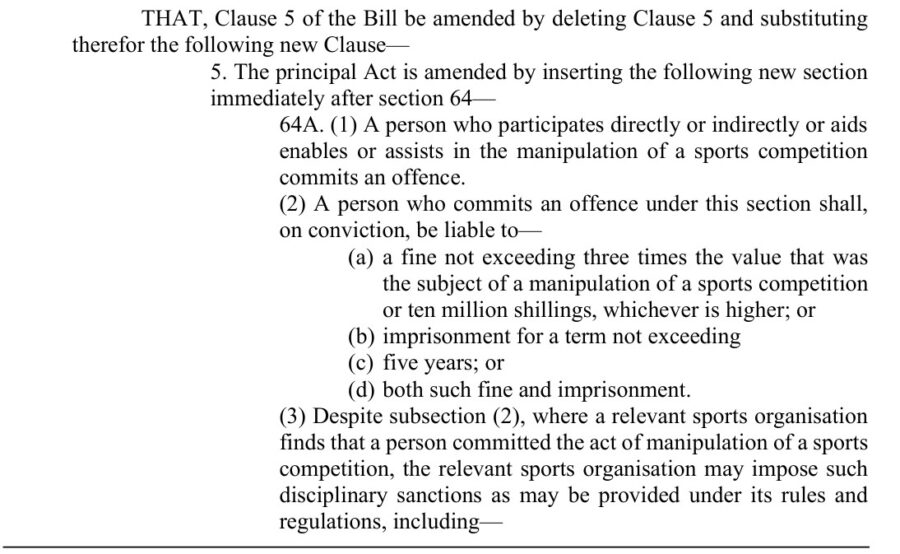
Under the amended Clause 5, anyone who directly or indirectly participates in, aids, enables or assists in manipulating a sporting competition commits an offence.
Mayaka told MPs that the original KSh1m (US$7,725) penalty was not sufficient. “Most Members felt that the initial fine that I had suggested in the Bill of KSh1 million was not punitive enough.”
The amended Bill provides for investigations by the Directorate of Criminal Investigations (DCI) and the relevant sports organisation, with the investigations operating independently.
Betting regulators join framework
Sports organisations will be able to require athletes, coaches, referees, administrators, clubs, leagues and others under their jurisdiction to provide information and records, conduct interviews and take other investigative measures. They will also be able to “cooperate and exchange information” with betting regulators, law-enforcement agencies, regulatory bodies, sports organisations and other competent authorities, subject to applicable confidentiality and data-protection laws.
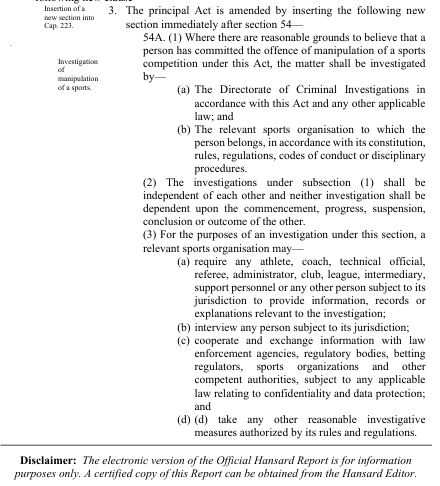
The framework creates a direct link between sports-manipulation investigations and Kenya’s betting regulatory system. Disciplinary action by a sports organisation will also not prevent the DCI from investigating potential criminal liability arising from manipulation.
The Committee also deleted the proposed role of Sports Kenya in conducting investigations. The Hansard says Sports Kenya lacks the institutional and technical capacity to investigate manipulation allegations, with investigations instead to be conducted by the DCI and relevant sports organisations.
Mayaka supported the change, saying sporting federations had raised concerns that including Sports Kenya in the investigation structure could undermine the independence of the process.
The Bill allows sports organisations to impose sanctions including fines, suspension, temporary or permanent bans, deregistration and forfeiture of proceeds or benefits gained through manipulation. Clubs or associations responsible for manipulation may also face forfeiture of the outcome of the affected match.
The amended definition of manipulation covers offering, giving, soliciting or receiving an undue advantage to improperly influence a sporting competition. It also covers conspiring to manipulate an event, deliberately underperforming to achieve a predetermined outcome, misusing insider information for betting or manipulation purposes, and facilitating, inducing or threatening someone to engage in manipulation.
The Bill now moves to the Senate for consideration. Its passage by the National Assembly marks the latest step in Kenya’s efforts to tackle match-fixing, with tougher penalties and formal information-sharing with betting regulators representing the key developments for the gambling sector.