

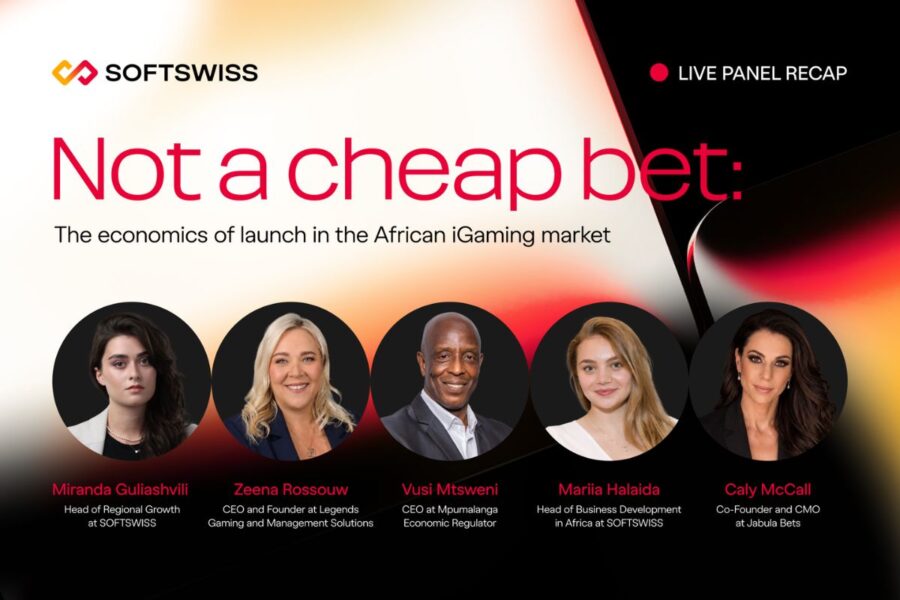
SOFTSWISS Panel: African igaming entry, why licensing is the smaller launch cost

The company’s panel reveals that localisation, certification, and payments outweigh initial licensing fees for new operators.
Key takeaways:
- SOFTSWISS hosted the panel “Not a Cheap Bet: The Economics of Launch in the African iGaming Market” featuring regulators and operators to examine true market entry costs in Africa.
- South Africa requires approvals across nine provinces, test lab certifications, SABS clearance, and 21 regulatory reports.
- Mariia Halaida, head of business development in Africa at SOFTSWISS, emphasised that game content must be fully customised rather than offered as a single one-size-fits-all portfolio.
- Some licensed operators approved over a year ago remain unlaunched due to additional software development needs.
- Experts advise operators to conduct ground-level feasibility studies and choose experienced platform providers over multi-million-dollar in-house builds.
Press release.- A panel hosted by SOFTSWISS demonstrated that securing a licence is merely a fraction of the total investment required to enter the African igaming market. Industry leaders and regulators underscored that navigating distinct payment methods, provincial certifications, and local compliance requirements poses a far greater financial challenge than initial licensing fees.
SOFTSWISS’ LinkedIn Live panel “Not a Cheap Bet: The Economics of Launch in the African iGaming Market” brought together the Mpumalanga Economic Regulator, operator Jabula Bets, consultancy Legends Gaming and Management Solutions, and SOFTSWISS to examine what market entry costs in practice, with South Africa as the main case.
Panellists agreed that Africa is a continent of separate markets. Africa comprises 54 countries that differ in licensing rules, anti-money laundering requirements, and player habits. Payments show the gap clearly: mobile money leads in Kenya, South African players use vouchers, electronic funds transfers, and cards, while other markets rely on USSD and agent networks. An operator may run a single platform across several countries, but still needs a separate compliance approach for each country. Game content also has to be tailored to each local audience.
South Africa showed how much work sits beyond the licence. Operators apply province by province, and each of the nine provincial authorities follows its own process. Approval can take three, six, or 12 months, depending on the province and complexity of the application. Products then need certification from a test lab and the South African Bureau of Standards (SABS). Platforms must also produce 21 market-specific regulatory reports. Some licensed operators approved over a year ago have still not launched because their software needed extra development.
Mariia Halaida, head of business development in Africa at SOFTSWISS, said: “Local content is crucial. If you want to operate in Kenya, you would have a different set of game providers than in West Africa or South Africa. So for us as a platform provider, aggregation provider, it’s crucial to offer our clients the content that would fit their needs and their markets. We don’t have just one offer for everyone out there. It’s completely personalised.”
Licensing itself is one of the smaller launch costs. Most spending goes to localisation, certification, a local company and staff, Broad-Based Black Economic Empowerment (BEE) requirements, technology, payments, and marketing. Operators often budget for a platform that can launch, not one that performs under real player volumes. Marketing needs steady investment to compete with established local brands. A slow platform, a failed deposit, or poor customer service can waste that spend: the operator pays to bring in a player who then meets a problem.
Practical advice centred on preparation. Operators should build a business strategy first, then compare markets against it. Panellists recommended a full feasibility study, talks with people on the ground, due diligence on every partner, and early work with a local partner and test lab. On technology, building a platform in-house can become a multi-year, multi-million project, so many operators choose an experienced provider instead.
Vusi Mtsweni, CEO at Mpumalanga Economic Regulator, added: “For international operators, don’t come to South Africa simply because the market is growing. Come because you understand the market, the regulatory environment, the consumer and the economics. And because you are prepared to invest for the long term.”
By Focus Gaming News Editorial Team