UK gaming hall sector confidence plummets amid government criticism and calls for machine game duty increase

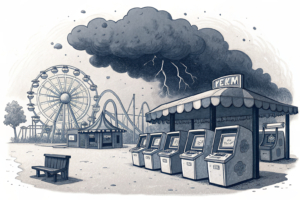
A survey of British gaming hall operators found major concerns for the future of the sector.
UK.- The UK gaming and amusement sector is facing a barrage of challenges at the moment amid negative government comments on the sector, plans to axe the aim to permit rule and now Gordon Brown’s support for a rise in Machine Games Duty. The UK gaming and amusement hall trade body Bacta has now warned that confidence in the future of the industry and support for the Labour government have “tanked” according to the responses of its latest Pulse Survey of industry members.
Conducted over seven days between August 7 and 14, the attitudinal survey of Bacta members reveals a sector that’s “hugely disillusioned with the government, massively concerned by the prospect of a potential increase in MGD and whose confidence in the future of the industry is shot”, the association warns. When asked if they were more or less confident about the future, 96 per cent of respondents confirmed they were less optimistic than they were prior to the July 2024 general election with 4 per cent stating they were uncertain.
The proposed rise in Machine Games Duty
In June, the Social Market Foundation (SMF), an influential think tank, proposed an increase in Machine Games Duty (MGD) on Category B slot machines to 40 per cent. That would bring them level with the new tax rate on online slots. Category B devices, which can pay out up to £500, are the most common type of electronic gaming machine in UK betting shops, arcades and bingo halls. They are currently subject to a MGD of just 5 per cent on stakes up to 20p, 20 per cent on stakes up to £5, and 25 per cent on stakes above £5.
For context, this is the same think tank that last year proposed a rise in Remote Gaming Duty from 21 to 50 per cent. The government eventually announced a rise to 40 per cent in the Autumn Budget, with the change coming into effect in April of this year. A rise in General Betting Duty from 15 to 25 per cent for online betting will follow in April 2027.
In Bacta’s survey, every respondent expressed concern at the impact a hike in the rate of MGD would have on their business with 96 per cent expressing extreme concern and 4 per cent stating they were ‘somewhat’ concerned. The worry was also apparent in voting intentions. The poll found that if Prime Minister Andy Burnham called a snap General Election, only 4 per cent of Bacta members would vote for Labour, while the same amount would spoil their ballot.
The situation is so severe that 44 per cent of respondents said they would resort to voting for Nigel Farage’s untested and shambolic Reform UK party, currently the subject of various controversies over murky donations. That compares to 40 per cent who would vote for the Conservative Party (40 percent). Plaid Cymru and the Liberal Democrats failed to register a single vote with the remaining 8 per cent of members ticking the box named Others.
Potential outcomes of an increase in MGD were listed as venue closures (31 per cent of respondents), reduction in investment (23 per cent), reduced staffing (15 per cent), customer price increases (8 per cent) and a reduction in profitability (8 per cent). Respondents were asked to provide the single biggest argument that the government should take on board before increasing MGD. The comments overwhelmingly expressed deep concern about the potential impact on Adult Gaming Centres (AGCs) and seaside arcades.
Respondents warned that a higher rate of MGD would make it unsustainable for venues to operate, especially those already facing tight margins some as low as 6 per cent. Comments highlighted that an increase in costs would force closures, particularly impacting SMEs and independents, leading to a loss of traditional seaside amusements and other community-based hubs such as membership clubs.
A recurring theme raised by respondents was the risk of significant job losses, especially among young adults for whom the industry often provides first-time employment. Business closures would not only increase unemployment but, as a consequence, also raise the welfare burden on the state.
Stakeholders also argued that raising MGD could paradoxically reduce the overall tax yield, citing international examples such as the Netherlands, where an increase in gambling tax has led to a net decrease in tax receipts. One respondent cited the Laffer Curve as evidence that the industry is rapidly approaching a taxation tipping point.
There was also concern that an increase in MGD could drive consumers to unregulated black-market alternatives, undermining consumer protection and the huge advances that have been made in the delivery of socially responsible gambling entertainment. Respondents also cited non-reclaimable VAT, rising business rates, and other operational costs, arguing that further tax increases are unsustainable.
A Bacta member’s view
Bacta has also cited detailed responses from various members to the proposal to raise MGD. There are grave concerns for the future of social clubs.
Chris Haley, Group Chairman of Dransfields, the largest British-owned supplier of gaming machines and entertainment products, said a tax hike would threaten the existence of many of the country’s circa 5,000 social clubs.
“Clubs exist at the heart of their communities and are owned by the members for the benefit of the members. Many operate on wafer thin margins with low or no cash reserves,” he said. “Unfortunately, it doesn’t take much for a club to go into a downward spiral; members will vote with their feet and go elsewhere if prices rise or if the club curtails entertainment and investment in the fabric of the club.”
He pointed out that massive uplifts in utility bills, staff costs, business rates, and bar stock have already forced an increasing number of clubs to open only at weekends. “There’s been a real sense of fear and trepidation,” he said. “There are not many options for clubs to make further cutbacks to compensate for a tax increase, and there is a real danger that some clubs will not be able to afford the rise and simply close.”
He also raised concerns about the government’s anti-gambling language. “Personally, it feels like an anti-gambling agenda,” Haley said. “I recognise that the government needs to raise revenue but if businesses are forced to close then revenue could actually reduce. It doesn’t seem sensible or desirable to penalise social clubs that time and again punch above their weight in terms of what they provide to their local community.
“To lose all those games of bingo that help ease loneliness, all the sports teams supported by their club, the funeral teas, the family parties, the community events, the charitable fundraising: the list goes on. In terms of authentic lived experience, I spoke to one of my club customers who said that their gaming machine income pays for the upkeep of their cricket pitch, bowling green, and football pitch, and these facilities are the bedrock of the local community and used by all generations.”