



How UK gambling reforms reshaped the remote market


Focus Gaming News examines how Britain’s gambling reforms have reshaped the remote market, tightening player protection and compliance while reinforcing the UK’s influence over regulatory approaches across Europe.
Key takeaways
- The UK introduced major remote gambling reforms between August 2024 and May 2025.
- Financial vulnerability checks began at £500 and later fell to £150 in net deposits.
- Online slots now have maximum stakes of £5 for adults and £2 for 18-to-24-year-olds.
- New rules restrict high-intensity game features and require real-time display of net spend and gambling time.
- The Gambling Commission will publish its assessment of the reforms’ short- to medium-term impacts later in 2026.
Britain’s 2024 gambling reforms have fundamentally changed how operators and suppliers approach player protection, financial risk and remote game design. The measures have increased compliance requirements across the market while reinforcing the UK’s position as a regulatory benchmark that other European jurisdictions may follow.
Special report.- This is the fourth in a series of special articles analysing how the gambling industry has evolved over the past decade, the challenges it has faced and what the future holds. In this special report, Focus Gaming News examines how Britain’s 2024 gambling reforms have reshaped the remote igaming market: why the Gambling Commission acted, how operators and suppliers have had to rebuild their products and compliance systems, what early market evidence shows, and whether Britain is becoming a template for other European regulators.
Gambling Commission new rules implementation timeline and details
By 2023, the British remote market was mature and still too capable of allowing extreme losses before any meaningful intervention. Examples cited at the time included a customer who spent £245,000 in three months despite being an NHS nurse earning about £30,000, and another who lost £70,000 in ten hours a day after opening an account. Slots sat at the centre of the risk case. Statistics had shown that slots accounted for the bulk of consumer losses – around 77 per cent of remote casino gross gambling yield (GGY).
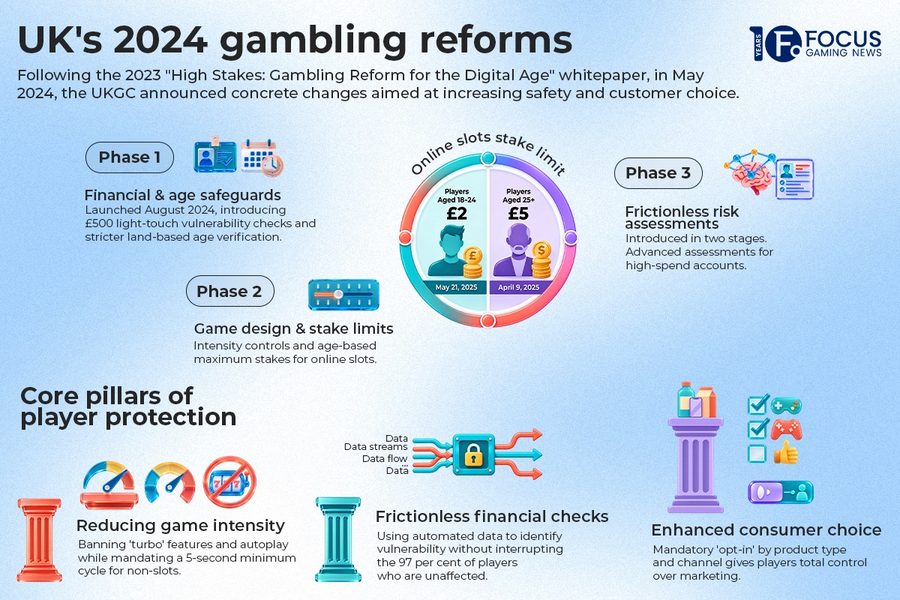
In April 2023, after well over a year of delays, the UK government published its gambling white paper, “High Stakes: Gambling Reform for the Digital Age”, which outlined a rough agenda of proposed regulatory measures for gambling. In May 2024, the Gambling Commission announced concrete changes aimed at increasing safety and customer choice. These included reducing the intensity of online games, improving consumer choice over receiving gambling marketing, light-touch financial vulnerability checks and tightening processes for age verification checks on premises. They were to be implemented in four stages: August 2024, November 2024, January 2025 and February 2025.
Helen Rhodes, director of major policy projects and evaluation at the regulator, said the reforms sat “at the heart” of “the continued drive to maintain consumer freedoms, empower consumer choice and protect vulnerable consumers.”
The changes, she said, ranged “from reducing the intensity of online games, to improving consumers’ direct marketing choices and power over depositing levels, to tightening age verification in premises, to making sure free bets and bonuses do not encourage harmful or excessive gambling.”
When asked why the Commission decided to roll out the reforms in several phases, she said: “It is important for consumers, businesses and the Commission that regulatory change is managed carefully. We have introduced a number of changes over recent years and have taken a phased approach, with changes being phased in over this time frame. This ensures a smooth customer journey and that the timetable for change is appropriate and proportionate.”
Light-touch financial vulnerability checks (FVCs)
The commission introduced proposals designed to improve the identification of acutely financially vulnerable online customers in the form of light-touch financial vulnerability checks for customers whose net gambling deposits exceed a rolling threshold. Using only publicly available data such as bankruptcy orders and unpaid debts, the checks do not use postcode or job title. The threshold started at £500 from August 30, 2024 and fell to £150 from February 28, 2025.
A pilot of frictionless financial risk assessments for gambling (FRAs)
On August 30, 2024, the Commission launched a three-stage pilot for proposed enhanced financial risk assessments to test data-sharing practices with credit reference agencies and gambling operators. Stage 1 findings involved over 530,000 assessments of 300,000 inactive customer accounts across three credit reference agencies.
The Gambling Commission reported that 95 per cent of checks were frictionless, with agencies able to automate feedback based on the data provided. Of the cases, 92 per cent had prior assessments, 3 per cent were classified as “thin files,” and 5 per cent failed mainly due to unmatched data. The report emphasised the need for improved data accuracy and consistency among operators, highlighting the variations in reporting methods between agencies and the need for standard definitions.
In the second stage of the pilot, approximately 1.7 million financial risk assessments were conducted across three credit reference agencies in relation to approximately 860,000 accounts. The proportion of assessments conducted without friction, which means without the player noticing, was 97 per cent. The figure was far better than the government’s 80 per cent estimate in the White Paper.
More recently, the commission said findings shows operators could enhance their frictionless assessment rates by tightening identity and age verification processes. It also concluded that registering customers with only an initial instead of a full name, or with a commercial address, undermined the checks credit reference agencies needed to run and said better verification upfront would translate into smoother customer journeys later on.
In July 2026, the Commission finally announced that it will advance with the introduction of FRAs in two stages: The first stage of implementation will see Financial Risk Assessments carried out only by the largest gambling operators in cases where there is high spend over a 24-hour period. For most, this will mean a £5,000 net deposit in a rolling 24-hour period, the regulator said.
In a second phase, Financial Risk Assessments will be applied to customers aged 25 years or older with net deposits exceeding £1,000 in a rolling 24-hour period or £3,000 over a rolling 90-day period. For those aged under 25, these thresholds will be £750 in a rolling 24-hour period or £2,000 in a rolling 90-day period.
During the early stages of implementation, no enforcement action will be taken on a failure to act following a Financial Risk Assessment, though operators are still subject to all other existing licence requirements.
A timetable for stage one implementation has not yet been announced.
Land-based age verification
From August 30, 2024, the requirement to carry out age verification test purchasing was extended to smaller land-based licensees, who had previously been exempt. Licensees were also ordered to update their procedures so staff would check the age of any customer who appears to be under 25 years of age, rather than under 21 years of age.
Remote game design
From January 17, 2025, revised Remote Gambling and Software Technical Standards (RTS) introduced intensity controls for online slots aimed at reducing speed and intensity. Key changes included banning features that speed up outcomes or create an illusion of control, such as “turbo” or “slam-stop” mechanics; prohibiting autoplay and celebrations for returns equal to or less than the stake; disallowing operator-led functionality that allows simultaneous play of multiple games; mandating a five-second minimum cycle on non-slots casino games while slots retained the existing 2.5-second floor; and requiring operators to display net spend and time spent gambling in real time.
Online slots stake limit
Stake limits on online slots were not in the Commission’s May RTS package. They required a statutory instrument from government. Following a delay in the parliamentary process due to the 2024 general election, this was introduced in the Gambling Act 2005 (Operating Licence Conditions) (Amendment) Regulations 2025. The reforms introduced a maximum stake of £5 per spin for players aged 25 and older, and £2 for those aged 18 to 24. The £5 limit was implemented on April 9, 2025, and the £2 limit for younger players on May 21, 2025.
Direct marketing
From May 1, 2025, operators were required to give players the option to opt-in to the product types they want to receive information on and the channels through which they wish to receive it. The change was intended to give customers more control over the direct gambling marketing they wish to receive and ensure they do not receive marketing that they do not want.
How has the industry responded to the UK Gambling Commission reforms?
Operators experienced the transition differently depending on where they sit in the market, but both suppliers who spoke to Focus Gaming News described the UK’s regulatory framework in largely positive terms.
Shawn Fluharty, head of government affairs at Play’n GO, said: “The UK remains one of the most advanced and influential regulatory environments in global iGaming. What sets it apart is not just the depth of oversight, but the willingness of the UK Gambling Commission to act early, decisively, and with a clear long-term vision for the sustainability of the industry.
“We’re seeing that play out again now as reforms continue to evolve. These measures aren’t about limiting the industry — they’re about strengthening it. A well-regulated market creates trust with players, policymakers, and the wider public, and that trust is ultimately what underpins long-term growth.
“At Play’n GO, we’ve always believed that regulation should be seen as a foundation, not a constraint. In fact, we’ve built our business exclusively around regulated markets, often taking positions ahead of formal legislative change because we believe that’s the only way to build a sustainable future.”
A spokesperson at TaDa Gaming said the current regulatory landscape in the UK is “considerably more complicated than it was a few years ago”. However, he said: “Despite the financial impact and increased bureaucracy, we see the evolving compliance requirements as a competitive advantage for providers and driving higher trust between players, operators and providers.”
When asked about the response from licensees so far, in terms of both operational readiness and overall support or concern regarding the direction of the reforms, Rhodes said: “Licensees, and all our stakeholders have actively engaged in consultations, flagging practical issues and concerns and making suggestions for improvements. We are pleased that we have had such active contributions to consultation and have made a number of changes following consultation as a result – for example, we made a number of changes following consultation on consumer-led tools, which have helped ensure the changes make sense for consumers and ensure a smooth transition. Our phased approach to implementation has also ensured operational readiness.”
How does the UK compare with other European gambling markets?
Focus Gaming News asked operators how the UK’s approach to player protection and regulatory oversight compares with that of other major regulated European markets.
“The UK is widely recognised as a global benchmark when it comes to player protection, and importantly, it’s a market that has shown real foresight in identifying risks before they become systemic issues,” Fluharty said. He cited the UK’s early ban on Bonus Buy mechanics as an example: “That was not necessarily a universally popular move at the time, but it demonstrated a deep understanding of how certain product features can impact player behaviour and long-term engagement.” Play’n GO, he said, reached the same conclusion on its own. “We made the decision not to include Bonus Buy features in our games, even in markets where they are permitted, because we don’t believe they contribute to a sustainable player experience,” he said.
Fluharty said other European regulators are moving in the same direction. “The Netherlands has already taken a similar stance, and we’re seeing increasing scrutiny of these mechanics across the European continent. That’s often how progress happens in this industry — a leading market takes action, and others adopt or adapt those principles over time.
“Across Europe more broadly, there is a clear direction of travel toward tighter regulation and greater accountability. But the UK continues to set the pace, both in terms of the standards it upholds and the speed at which it implements them.”
TaDa Gaming’s spokesperson added: “The UK’s regulatory framework has always been seen as the industry benchmark and so it makes sense that its approach is more rigorous than most other jurisdictions.”
What’s next for UK gambling regulation?
Both operators agreed that the future of the UK industry depends on demonstrating the economic value of igaming while ensuring that regulation fosters rather than stifles the innovation essential to this value.
TaDa Gaming’s spokesperson said: “One of the biggest opportunities is in showcasing igaming as a significant and impressive contributor to the economy, employment and innovation. The main challenge from regulation is the risk of stifling innovation and growth. Open dialogue between our industry and regulators will be key, particularly around consistent standards, responsible gaming and emerging technologies.”
Fluharty made a similar comment: “The UK remains a hugely important opportunity for the industry because it is a mature, highly engaged market with players who expect — and reward — quality, innovation, and responsibility in equal measure.
“The challenge, as always in a leading market, is that expectations continue to rise. Regulatory frameworks will keep evolving, and rightly so, but the industry must ensure it keeps pace in a way that supports innovation rather than stifling it.”
“That’s where collaboration becomes critical. The most effective regulatory outcomes come when there is a shared understanding between regulators and industry about what we’re trying to achieve – a safe, sustainable, and genuinely entertaining product for players.
“There is also a strong case for greater standardisation across regulated markets, particularly in Europe. While local nuances will always matter, aligning on core principles – such as responsible product design, player protection measures, and compliance expectations – would make it easier for the industry to operate efficiently while maintaining high standards.
“Ultimately, the UK’s greatest strength is its willingness to lead. Whether it’s around affordability, marketing restrictions, or product design, it has consistently been prepared to take difficult decisions in the interest of long-term sustainability. The opportunity now is to continue that leadership, working in partnership with industry to shape a framework that delivers both protection and progress – not just in the UK, but globally.”
When asked how the Gambling Commission is assessing the impact of the reforms, and what the main challenges or priorities are for the next stage of regulation, Rhodes said: “Right from the outset we’ve strongly felt it was important to evaluate significant changes to regulation. This is why we have jointly commissioned work with DCMS (delivered by the independent National Centre for Social Research) to establish if changes introduced to date have been delivered effectively, if there are any unintended consequences, and capture learning to inform future policy development. Reporting on short to medium term impacts of the changes will be published later this year. From there, our focus will broaden to include monitoring and evaluation of changes that are not yet in effect.
“Work to date has given a platform for a diverse range of stakeholders to contribute their unique perspectives and views on the policy measures under review. This helps to ensure that evaluation findings are comprehensive, balanced and fully informed.”
Frequently asked questions (FAQs)
- What changed in the UK gambling market under the 2024 reforms?
The reforms introduced financial vulnerability checks, tighter game-design rules, online slots stake limits and greater consumer control over gambling marketing. - What are the UK’s online slots stake limits?
The maximum stake is £5 per spin for players aged 25 and over and £2 for players aged 18 to 24. - What are Financial Risk Assessments in UK gambling?
Financial Risk Assessments use information from credit reference agencies to identify potential financial risk among higher-spending gambling customers. - Why is the UK gambling framework considered a European benchmark?
Industry stakeholders interviewed by FGN say the UK has repeatedly acted early on player-protection risks, with other European regulators adopting or considering similar measures.
This article is the fourth instalment of a series produced by Focus Gaming News to mark its tenth anniversary. Over the course of 2026, the articles will examine the most defining moments that shaped the global igaming industry between 2016 and 2026, from regulatory changes and market openings to technological shifts and the rise of new regions. Each piece will be accompanied by exclusive interviews with the executives, regulators and analysts who were part of these changes.
By Focus Gaming News Editorial Team