The casino that could belong to anyone: ICONIC21
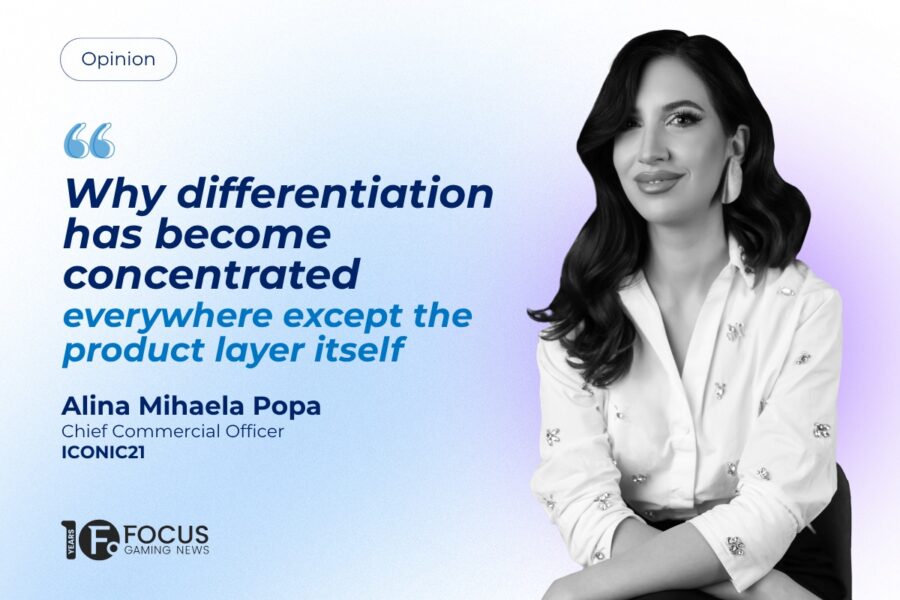

Alina Mihaela Popa, Chief Commercial Officer at ICONIC21, analyses how online casino operators can achieve brand differentiation within the product layer.
Opinion.- I was discussing brand positioning with an operator recently when they asked a simple question: if you removed our logo, would a player know they’re in our casino?
It wasn’t a question about acquisition, promotions or even content volume. It was a question about identity. Because, if we are being honest, despite all the effort operators invest in standing apart, much of the actual casino experience remains surprisingly similar across the market.
In this article, I will argue that differentiation has become concentrated everywhere except the product layer itself, explain how the industry’s commercial model created that reality, and explore why the barriers that once made bespoke experiences impractical are beginning to disappear.
Variety is no longer your biggest USP
For years, the industry’s focus was straightforward: more content, faster distribution and broader reach.
Aggregators made it easier for operators to access large game portfolios, while providers competed to increase catalogue size. The result was a market where access became abundant. Most operators can now offer many of the same games as their competitors.
That model solved an important business problem, but it also created an unintended consequence. As content becomes widely available, casinos naturally begin to resemble one another. The ability to access games is no longer rare. The challenge is creating an experience that feels distinct.
Operators differentiate everywhere else
What’s striking is that operators already understand the value of differentiation.
Go to any conference and it will include panels on branding, standing out, CRM, localisation or promotional strategy. Every detail is carefully considered because they know that standing apart matters in increasingly competitive markets.
Yet the product experience itself is often treated differently.
Somewhere along the way, the industry accepted an assumption that the games and environments players spend their time in would inevitably be shared. Differentiation became something built around the product rather than within it.
The constraint was real
To be fair, this wasn’t simply a failure of imagination.
Historically, creating tailored experiences required significant time, investment and development resources. Bespoke projects were difficult to justify commercially when standardised solutions could be deployed faster and at lower cost.
As a result, operators learnt to view standardisation as a permanent feature of the market rather than a response to technological and operational limitations.
The important question today is whether that assumption still holds true.
Customisation means more than branding
When customisation is discussed, the conversation often starts and ends with visual changes.
A branded table, a different colour scheme or a logo on the felt can certainly reinforce an operator’s identity. But those elements alone do not create a recognisable experience.
The opportunity lies in giving operators greater influence over how products are designed, presented and aligned with their commercial strategy. The goal is not exclusivity for its own sake. It is creating experiences that feel connected to the brand players chose in the first place.
For us, that means listening closely to what operators are actually trying to achieve.
That is precisely why we build our roadmap around operator needs. Whether it’s dedicated studio environments, tailored game experiences, AI-powered dealers, promotional mechanics or faster delivery cycles, the goal is always the same: helping operators create a casino experience that reflects their own identity rather than everyone else’s.
The objective is not to add more content, but to make the content layer work harder for the operator’s brand.
A different commercial conversation
At ICONIC21, this shift in thinking has shaped how we approach development. Through dedicated capacity and continued investment in production capabilities, including the announcement of our recent expansion of our operations in Vilnius, we have focused on helping operators create experiences that reflect their own priorities rather than simply expanding catalogue access.
That does not mean every operator needs something completely unique. It means recognising that differentiation can exist within the product layer, not just around it.
As content continues to converge across the market, the most important question may no longer be who offers the most. It may be who offers an experience that feels unmistakably their own.
By Focus Gaming News Editorial Team