Love at first integration? Why the best B2B partnerships start long before the API launch, according to Onlyplay
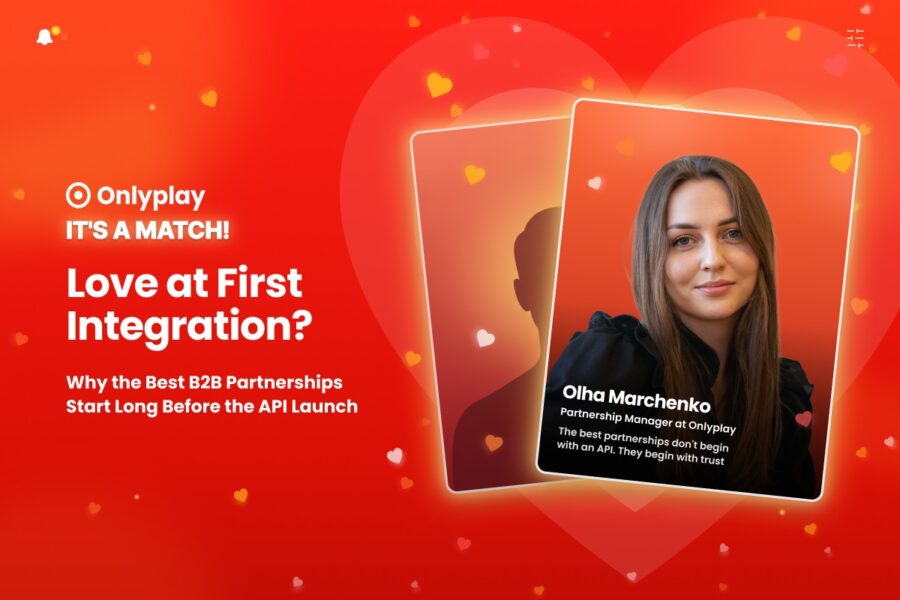

In the following exclusive article for Focus Gaming News, Olha Marchenko, Partnership Manager at Onlyplay, discusses why communication and trust drive successful B2B igaming integrations far more than technical processes.
Opinion.- Olha Marchenko, partnership manager at Onlyplay, works closely with providers, aggregators, and operators throughout every stage of the partnership journey. From her experience, the path from an initial conversation to a successful game launch is rarely linear. As she explains, the speed of an integration is influenced far more by communication between people than by the technical aspects of the process itself.
First impressions are only the beginning
In B2B igaming, people often judge partnerships by how many integrations are completed, how quickly they go live, or how much revenue they generate. But real success starts well before the first API call.
As with any long-term relationship, the first meeting doesn’t decide everything. Both sides need time to learn about each other’s expectations, ways of working, priorities, and long-term goals before building something continuous.
That’s why the best integrations usually start at the negotiating table, not in a technical chat room.
The first compatibility test: Negotiations that shape the future
Many people see commercial negotiations as just about rates. But this is really when both companies see if they can agree, talk openly about expectations, and build a deal that works for everyone. Experience has shown that rushing forward to sign a contract does not always lead to the strongest partnerships. When one side accepts terms it doesn’t truly believe are fair, those compromises often resurface later in the relationship.
The best partnerships happen when both sides stick to their views but are also open to comprehending each other.
One partnership illustrates this particularly well. Commercial negotiations alone lasted nearly a month before both companies agreed on terms that worked for everyone. After the agreement was signed, another six months were spent completing the integration, aligning technical requirements, and preparing for launch. On paper, the process seemed unusually long. In practice, however, the partnership generated exceptional revenue from its very first month live, fully justifying the time and effort invested by both teams.
“We eventually agreed on commercial terms that reflected the value of our product. The integration itself took another six months, but from the exact first month after going live, the partnership generated outstanding revenue. That experience reinforced something we strongly believe: taking more time upfront is often worth it if it helps build a healthier partnership in the long run.”
Olha Marchenko, partnership manager at Onlyplay.
Sometimes the most valuable partnerships are not the ones that begin the fastest.
The real challenges begin after the contract is signed
It is easy to assume that once the paperwork is complete, all that remains is to connect the API and run technical tests.
In reality, that is when the most demanding part of the journey begins.
Legal teams, compliance experts, account managers, QA engineers, platform reps, aggregators, operators, and developers all get involved. Each group has its own priorities, approval steps, and schedules. That’s why two integrations that look the same can end up taking very different amounts of time.
Integration queues constitute a common issue. The contract is signed, and documents are ready, but the technical team is busy with other projects.
This is often when you see the real difference between only a transaction and a true partnership.
Olha Marchenko recalls one case in which an integration stalled for several months simply because the partner’s technical team had a full development pipeline. Everything changed after the two companies met in person at an industry conference. A single face-to-face conversation helped identify the right stakeholders, revisit priorities, and move the project forward. What months of emails failed to accomplish was resolved over one discussion.
“At Onlyplay, we see integration as a collaborative process rather than a technical task. When both sides trust each other, communicate openly, and understand each other’s priorities, even the most complex projects move forward much faster.”
Olha Marchenko, partnership manager at Onlyplay.
When partners ask for the impossible
The most interesting challenges don’t usually come up during standard integrations. They happen when a partner asks for features that go far beyond what the product can currently do.
At first, it might look like the Partnerships team just passes requests to developers and waits for them to build it, but in reality, their role is much more strategic.
Before saying yes to custom development, the team tries to understand the real business goal behind the request. Often, there’s another way to achieve the same result that uses fewer resources and benefits both companies.
“At Onlyplay, we don’t simply coordinate integrations. If a partner sees a solution differently, our job is to understand their perspective, explain ours, and work together to find an approach that delivers value for both businesses.”
Olha Marchenko, partnership manager at Onlyplay.
At this stage, the Partnership Manager does more than just coordinate projects. They join product discussions and help connect business goals with technical needs.
Every relationship eventually meets reality
A smooth first integration might make it seem like the hardest part is done.
But in truth, going live is just the start.
Markets change. Regulations shift. Operators move into new areas. Product strategies evolve. Features that worked well six months ago might need updates to fit new conditions.
This is where long-term partnerships truly prove their value.
At Onlyplay, the best partnerships keep growing. Partners come back with new ideas, try out promotions, test engagement tools, and adjust products for new markets. As the relationship grows, both teams understand each other better, so future projects move faster and more smoothly.
Sometimes the best solution is to say “No”
Good service is often mistaken for agreeing to every customer request. But it’s not that simple.
Sometimes a partner requests a feature that would take months to build but wouldn’t actually help the business much. In these situations, the Partnerships team shouldn’t just agree. They should have an honest conversation about the options and suggest the solution that will really make a difference.
That’s why Onlyplay looks at every unusual request from both a technical and business angle.
Sometimes that involves investing in a complex customisation. Sometimes it means proposing a smarter alternative, and sometimes it means explaining why an idea probably won’t give the results the partner hopes for. Ironically, these honest talks often build the most trust.
Why face-to-face meetings still matter more than dozens of online meetings
Although most day-to-day communication now happens through Slack, Teams, or email, in-person meetings remain one of the most effective ways to build lasting business relationships.
Industry conferences give people a chance to talk about more than just project timelines or KPIs. They let both sides discuss future plans, understand each other’s priorities, and build real connections.
According to Marchenko, many long-standing issues have been resolved during conversations that happened outside meeting rooms rather than inside them.
Sometimes just an hour over a coffee is enough to figure out why an integration is stuck, spot internal issues, and identify a solution that works for everyone.
In the end, it’s people who build partnerships, not companies.
The strongest partnerships are built on small details
In large B2B projects, it’s easy to focus just on deadlines, paperwork, and technical tasks. But often, it’s the little gestures that show the real quality of a partnership—like remembering a partner moved to a new country, asking about their conference, congratulating them on a personal event, or bringing a toy for their dog they mentioned months ago.
You won’t find these instances in a CRM or a quarterly report. But these are often what turn a business relationship into a real partnership.
Green flags of a strong partnership
Like any long-term relationship, strong B2B partnerships grow from lots of small actions that slowly build trust.
At Onlyplay, those signs include:
- Speaking openly and honestly, with no hidden expectations.
- Explaining not just what needs to be done, but also why it matters.
- Respecting each other’s time, priorities, and ways of working.
- Focusing on finding solutions instead of trying to win every argument.
- Staying involved after launch through Partnerships, Account Management, and Support—not just during integration.
Red Flags that can undermine even the best integration
Some behaviours always make working together harder, no matter how good the product is.
These include:
- Requesting extensive custom development without a clear business rationale.
- Long periods of silence after negotiations or during integration
- Constantly shifting priorities without candid communication.
- Expecting one side to do all the adapting while offering no flexibility in return.
- Thinking of integration as the end, instead of the start of a long-term partnership.
The best integrations don’t begin with an API
In B2B igaming, it’s easy to focus on how fast integrations happen, release dates, or technical performance.
But behind every successful launch, there’s something more important than just clean code.
It’s about trust, honest conversations, a true understanding of each other’s goals, and working together to find solutions that benefit both sides.
That’s why, at Onlyplay, we never see integration as the end of the conversation.
It’s the start of a long-term partnership.
“For me, integration has never been the finish line. It’s where the real partnership begins. If you’ve invested the time to build trust from the very beginning, everything that follows, from the first launch to expansion into new regulated markets, becomes significantly easier.”
Olha Marchenko, partnership manager at Onlyplay.
And when that foundation is built well, everything that follows, from the first launch to expansion into new regulated markets, becomes significantly easier.
By Focus Gaming News Editorial Team