Moreno Marasco, LOGiCO: “Consumer protection requires effective and targeted rules, not a blanket prohibition”
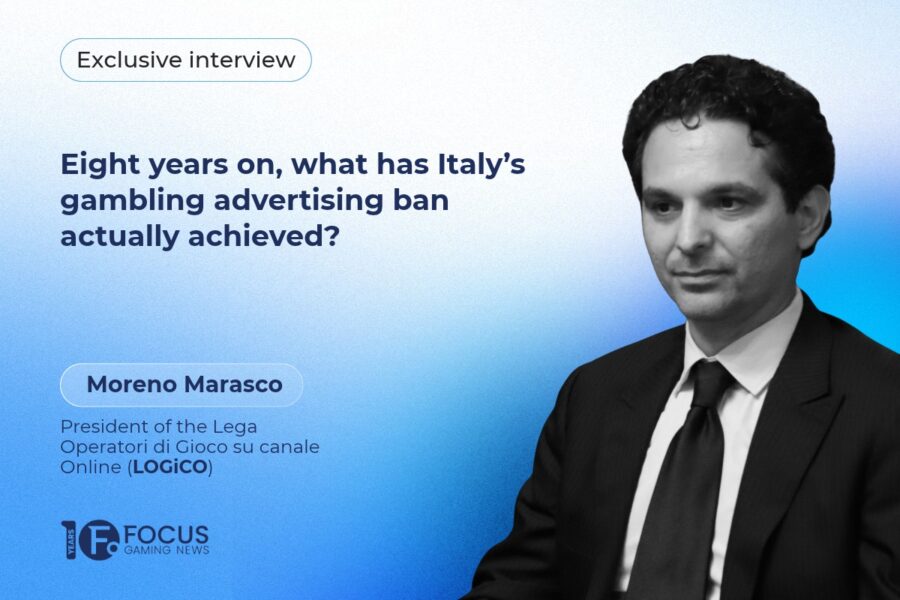
LOGiCO president Moreno Marasco says Italy’s blanket gambling advertising ban has weakened the visibility of licensed operators while illegal alternatives remain exposed to consumers.
Key takeaways:
- LOGiCO president Moreno Marasco says Italy’s 2018 blanket gambling advertising ban should be judged on measurable outcomes, including problem gambling, minors’ exposure, illegal market growth and consumers’ ability to identify licensed operators.
- He argues the ban has restricted licensed operators’ communication without removing consumer exposure to gambling offers, including from illegal operators.
- LOGiCO proposes replacing the blanket prohibition with a qualitative ban on aggressive, deceitful or misleading advertising, while permitting responsible gambling communication.
- Marasco welcomes AGCOM’s updated guidance but says further clarity is needed on brand references, corporate communication and how prevention messages will be applied in practice.
- He identifies illegal gambling, evidence-based consumer protection and greater European regulatory coordination as the industry’s main priorities.
Moreno Marasco, president of Italy’s Lega Operatori di Gioco su canale Online (LOGiCO), has called for Italy’s blanket gambling advertising ban to be replaced with a framework that prohibits aggressive, deceitful or misleading advertising while allowing licensed operators to communicate responsibly. He argues that the ban, in place since 2018, has made it harder for consumers to distinguish legal operators from illegal alternatives without demonstrably reducing gambling-related harm. Marasco also calls for clearer guidance on prevention communications and greater regulatory coordination across Europe.
Exclusive interview.- Exclusive interview.- Nearly eight years after Italy introduced its blanket ban on gambling advertising, questions remain over whether the restrictions have achieved their intended consumer-protection objectives or inadvertently strengthened the position of illegal operators. With licensed gambling companies facing strict limitations on commercial communication, the debate is increasingly focused on whether a more proportionate, evidence-based approach could better protect vulnerable consumers while preserving the visibility of the regulated market.
Ahead of his participation in the “Advertising ban: from prohibition to a balanced approach” panel at SiGMA World 2026, Moreno Marasco, President of the Lega Operatori di Gioco su canale Online (LOGiCO), spoke to Focus Gaming News about the consequences of Italy’s gambling advertising ban, the implications of AGCOM’s updated guidance on responsible gambling communications and the different regulatory approaches emerging across Europe. He also discussed the importance of tackling illegal gambling through stronger enforcement against payment infrastructure, improving evidence-based consumer protection and developing greater regulatory coordination across European markets.
Looking back at Italy’s gambling advertising ban since 2018, which outcomes should carry the most weight in judging whether it has worked, and what does the evidence show?
The first point I would make is that the ban should be judged against the objectives used to justify it: reducing gambling-related harm, protecting minors and vulnerable consumers, and limiting excessive exposure to gambling. On these terms, I believe its effectiveness is highly questionable.
LOGiCO challenged the ban from the outset, because we considered a blanket prohibition both disproportionate and potentially counterproductive. Almost eight years later, the fundamental question remains: what has the ban actually achieved in terms of reducing problem gambling or protecting vulnerable consumers? The disappearance of commercial advertising from mainstream channels is not, in itself, evidence of improved public health.
There is also a significant unintended consequence. By severely restricting the ability of licensed operators to communicate, the ban has weakened the visibility of the legal market and made it harder for consumers to distinguish authorised operators from illegal alternatives. Illegal operators, which do not comply with Italian rules in the first place, are not subject to the same practical constraints.
In my view, this is the central contradiction of the Italian approach: it has restricted the communication of the regulated industry without removing consumers’ exposure to gambling offers, including those coming from illegal sources.
We should therefore look at measurable outcomes, including trends in problem gambling, the exposure of minors, the development of illegal gambling and consumers’ ability to identify licensed operators. A proper assessment should establish whether the ban has actually improved these indicators, rather than simply assume that less advertising means less harm.
Our position has always been that consumer protection requires effective and targeted rules, not a blanket prohibition. The experience of recent years has made the case for reconsidering the current approach even stronger.
“The disappearance of commercial advertising from mainstream channels is not, in itself, evidence of improved public health.”
Moreno Marasco, president of LOGiCO.
If LOGiCO were drafting a replacement for the blanket ban, which forms of advertising would it permit, and which would remain prohibited?
In fact, LOGiCO proposed a very simple legislative amendment from the very beginning: replace the blanket prohibition with a qualitative ban targeting aggressive and deceitful advertising, while allowing responsible gambling advertising.
This was not an abstract proposal. LOGiCO was the first industry association to promote this kind of communication, launching its own responsible gambling television campaign back in 2018. We believed then, and continue to believe, that communication can be part of the solution rather than something that should be prohibited altogether.
The two elements of our original proposal have progressively become even more relevant. On the one hand, there is growing recognition of the need to identify and prevent aggressive, misleading or otherwise irresponsible advertising. On the other, responsible gambling communication has become an increasingly important component of the industry’s commitment to consumer protection.
A replacement framework should therefore allow licensed operators to communicate their brands and products responsibly, including through traditional and digital advertising, corporate sponsorships and direct communication with adult customers who have explicitly consented to receive it. It should also allow operators to communicate prevention messages, responsible gambling tools and the safeguards associated with the legal offer.
Conversely, advertising that is aggressive, deceitful or misleading should remain prohibited, as should communications directed at minors, content with particular appeal to children, messages suggesting that gambling is a solution to financial difficulties or a route to social success, and any form of promotion that encourages excessive or irresponsible play.
Direct marketing should be subject to appropriate safeguards, including strict protection for self-excluded customers and people showing signs of problematic gambling.
The principle is straightforward: prohibit irresponsible advertising, not advertising as such. The regulatory objective should be to ensure that communication is responsible, transparent and consistent with consumer protection, while allowing the legal market to remain visible.
“Advertising that is aggressive, deceitful or misleading should remain prohibited.”
Moreno Marasco, president of LOGiCO.
How do you assess AGCOM’s updated guidance on responsible gambling communications: does it provide a workable distinction between prevention and promotion, or do important uncertainties remain?
The updated guidance is a useful step because it recognises the need to distinguish communications genuinely intended to prevent gambling-related harm from commercial advertising. This distinction is important, particularly in a regulatory environment where the blanket prohibition has made it difficult to communicate even messages aimed at protecting consumers.
However, we should be careful not to confuse the existence of guidance with the achievement of legal certainty. Some of the criteria remain restrictive, and there are still questions about how the distinction will be applied in practice.
For example, the treatment of an operator’s identity, brand references and corporate communication needs to be sufficiently clear. If a licensed operator contributes to a prevention campaign, it should be possible to identify who is responsible for that initiative without automatically turning the communication into advertising. Equally, information about tools such as deposit limits, self-exclusion and other player-protection measures should be capable of reaching consumers in a recognisable and accessible way.
There is also a practical issue of consistency. Operators need to know in advance which elements are permitted and which could expose them to sanctions. If every individual communication is subject to uncertainty or a potentially different interpretation, the guidance will not provide the predictability that the industry needs.
We welcome AGCOM’s effort to clarify the framework, but we believe that further dialogue between the Authority and the industry will be important to ensure that prevention communication can genuinely fulfil its purpose, without becoming an indirect route for commercial promotion or, conversely, being restricted to the point of ineffectiveness.
Looking across Europe, how do you assess the direction of gambling advertising policy, and where should policymakers draw the line between protecting consumers from excessive exposure and allowing licensed operators to remain visible?
There is no single European approach. Countries have adopted very different models, ranging from near-total prohibitions to systems that allow advertising subject to restrictions on content, audiences, channels and timing. A recent comparative review of 30 European jurisdictions confirms this diversity, with Italy and Latvia among the very few countries applying near-blanket bans.
What I find important is that the debate should move beyond the assumption that the more restrictive the advertising regime, the greater the level of consumer protection. The effectiveness of a measure depends on its design, enforcement and interaction with the wider regulatory system.
There are legitimate reasons to restrict excessive exposure, particularly among minors and vulnerable consumers. Restrictions on advertising content, targeting, timing and direct marketing can all play an important role. But these safeguards do not necessarily require making licensed operators invisible.
In fact, visibility of the legal market has a consumer-protection function. Consumers should be able to recognise authorised operators, distinguish them from illegal websites and understand the standards and safeguards that apply to the legal offer. A regulatory framework that limits this possibility risks creating an information imbalance between the legal and illegal markets.
I believe European policymakers should focus on a proportionate model: strict protection for minors and vulnerable groups, clear restrictions on irresponsible promotional practices, effective enforcement against illegal advertising, and sufficient room for licensed operators to communicate transparently with adult consumers.
Greater coordination between European regulators would also be valuable. International operators often face different requirements for the same brand, product and platform. More information-sharing and standardisation could reduce unnecessary fragmentation while helping to maintain consistent consumer-protection standards.
Beyond advertising, what do you see as the most pressing challenges facing Europe’s gambling industry, and where should operators and regulators focus their efforts over the next few years?
I would identify three main priorities: tackling illegal gambling, improving the effectiveness and consistency of consumer protection, and creating a more coherent regulatory environment across Europe.
The fight against illegal gambling should be at the top of the agenda. Blocking individual websites is not enough, because domains can be replaced relatively easily. Authorities need to target the economic infrastructure that allows illegal operators to function, particularly payment services, financial flows and the companies facilitating access to these services. We are beginning to see more countries consider or implement payment-blocking measures, and I expect this approach to become increasingly important.
The second priority is to make consumer protection more effective and evidence-based. The industry should continue investing in responsible gambling tools, early identification of risky behaviour and the development of common standards. LOGiCO is particularly committed to this area, including through its contribution to the European standardisation work that led to EN 18144 on markers of harm. This is an example of how operators, associations and institutions can work together to develop practical tools rather than simply add further formal requirements.
Finally, Europe needs greater regulatory coordination. Operators active in several countries face increasingly complex and sometimes inconsistent requirements, even when they are dealing with the same brands, products and technological platforms. More information-sharing and common standards, where appropriate, would benefit both international businesses and regulators, while making compliance more efficient and predictable.
Ultimately, the challenge is to build a sustainable legal market that can compete effectively with illegal operators while maintaining high standards of consumer protection. This requires responsibility from the industry, but also regulation that is proportionate, coherent and focused on measurable outcomes.
By Focus Gaming News Editorial Team