
Kangwon Land Q3 operating profit falls 17.9%
The operator’s third-quarter results reflected weaker mass gaming activity, lower hotel revenue and fair-value losses on financial assets.
Key takeaways
- Kangwon Land’s Q3 operating profit dropped 17.9 per cent to KRW59.7bn (US$44.3m), while the company swung to a KRW3.63bn (US$2.7m) net loss.
- Casino revenue declined 1.8 per cent to KRW327.8bn (US$243.2m).Non-gaming revenue fell 17.4 per cent to KRW41.7bn (US$30.9m).
- Kangwon Land had spent KRW110.1bn (US$81.7m) of its KRW145.4bn (US$107.9m) 2026 capital expenditure budget by September 30.
- The operator plans a KRW20bn (US$14.8m) share buyback before year-end 2026, subject to board approval, under its shareholder return policy.
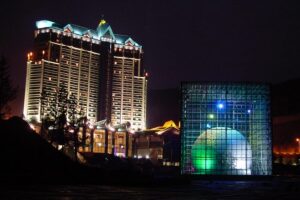
South Korea.- Kangwon Land, South Korea’s only casino open to local residents, recorded operating profit of KRW59.7bn (US$44.3m) in Q3 2026. The figure was down 17.9 per cent from the same period last year, as revenue from casino and non-gaming operations declined. Operating profit was down from KRW72.70bn (US$53.9m) in Q3 2025, although it increased 36.2 per cent from KRW43.80bn (US$32.5m) in the second quarter of 2026.
In its consolidated preliminary results, published on November 6, the company reported revenue of KRW369.45bn (US$274.1m), down 3.8 per cent year-on-year. Kangwon Land moved into a net loss of KRW3.63bn (US$2.7m), compared with a net profit of KRW113.07bn (US$83.9m) a year earlier. Pre-tax profit fell to KRW3.74bn (US$2.8m) from KRW144.76bn (US$107.4m) in Q3 2025.
The company attributed the decline in net income partly to fair-value losses on financial assets following an increase in bond yields.
Casino operations generated revenue of KRW327.8bn (US$243.2m), down 1.8 per cent year-on-year. Gross gaming revenue (GGR) declined 2.5 per cent to KRW359.4bn (US$266.7m) while visitor numbers slipped 3.2 per cent year-on-year to 640,039.
The mass gaming segment generated GGR of KRW294.9bn (US$218.8m), down 4.8 per cent year-on-year amid a 3.4 per cent decline in mass gaming visitors and a 6.5 per cent decrease in drop. VIP gaming provided some support, with GGR increasing 9.6 per cent to KRW64.5bn (US$47.9m). VIP visitation rose 11.1 per cent, while the drop increased 5.2 per cent.
Non-gaming revenue was KRW41.7bn (US$30.9m), down 17.4 per cent year-on-year. Hotel revenue declined 21.6 per cent to KRW20.9bn (US$15.5m), while condominium revenue fell 12 per cent and Water World revenue decreased 14.5 per cent.
The company linked the weaker performance to accommodation renovation work that affected the availability of hotel and condominium rooms. Kangwon Land began renovating 757 rooms in March 2026, including 477 rooms at the Grand Hotel Main Tower and 280 rooms at the Mountain Condominium. It expects the Mountain Condominium renovation to be completed in Q4 2027, while work at the Grand Hotel Main Tower is scheduled to finish in Q1 2028.
For the first nine months of 2026, Kangwon Land generated consolidated revenue of KRW1.094tn (US$811.8m), down 1.6 per cent. Operating profit declined 16.1 per cent to KRW172.39bn (US$127.9m) and net profit decreased 41.8 per cent to KRW145.90bn (US$108.3m).
The operator budgeted KRW145.4bn (US$107.9m) for capital expenditure in 2026 and had spent KRW110.1bn (US$81.7m) by the end of September. Its projects include guest room renovations, the remodelling of its VIP gaming area and the construction of a second casino floor.
Kangwon Land’s 2024–2026 shareholder return policy aims to maintain a dividend payout ratio of at least 50 per cent and a total shareholder return of 60 per cent through dividends and share buybacks. As part of the policy, the company plans to repurchase KRW20bn (US$14.8m) worth of its own shares before the end of 2026, subject to board approval.