
Alexandre Tomic: “With Alea’s Jackpot we’re in a very specific position to provide a tool that takes all the needs that operators have in this type of tool”
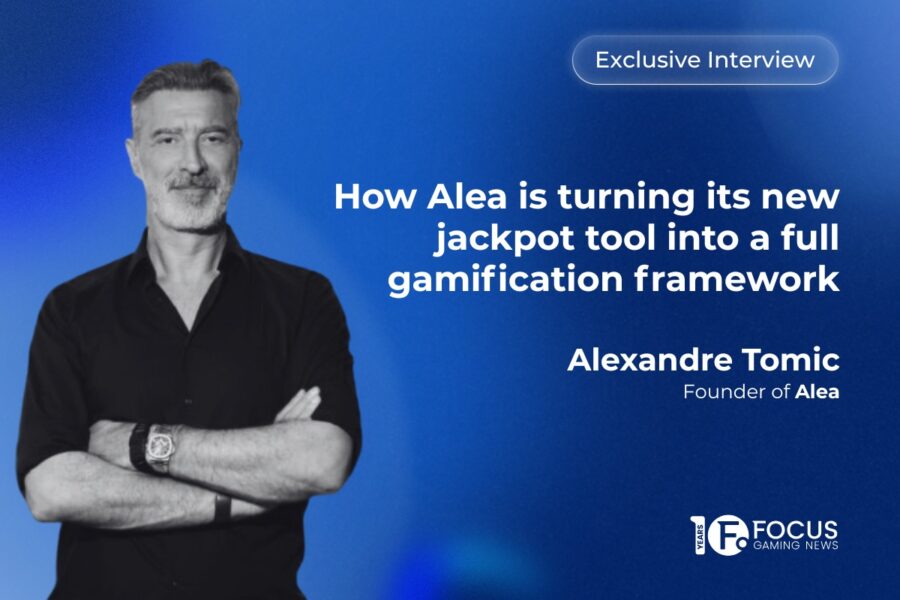

Focus Gaming News spoke with Alexandre Tomic, founder of Alea, about the aggregator’s new jackpot tool, the feedback he got from iGB L!VE, and the company’s strategic priorities for the remainder of 2026.
Exclusive interview.- At iGB L!VE this week, Alexandre Tomic, founder of Alea, discusses the market response to the company’s new jackpot tool, the strategic importance of iGB L!VE, and the advantages of building an agnostic jackpot system across thousands of games. He also shares his perspective on the future of gamification, the challenges AI may bring to the aggregation sector, and how Alea plans to maintain its relevance and competitive edge as the igaming ecosystem continues to evolve.
It has been 6 months since you launched your new jackpot feature at ICE. How has the market response been so far?
Well, we are still in beta mode. We launched it with customers who were on a waiting list. Why are we in beta mode? We are adapting the business model of the jackpot platform. So, what we wanted to do at the beginning was build a tool where operators can make money on top of it. It’s a side bet that the player is doing, let’s say 10 or 20 cents on top of their €1 bet, and on that 10 or 20 cents, the operator can put a 10, 15, 20, or 30 per cent house edge, of which Alea is going to take a little part.
Now, some of our customers have requested that we not do that because they want to fund the jackpot themselves, as they consider it a marketing tool. So we’re making these little tweaks and, basically, we’re testing the business model of the jackpot with our premium historical customers.
We’re going to do a full release around September, so I’m going to be able to give you more numbers, hopefully during ICE. But it’s going very well, and we have a lot of people requesting it.
What were Alea’s main goals for iGB L!VE 2026?
iGB L!VE, whether it’s in London or previously in other locations, has always been an important show for us. Always a vibrant show. To be honest, I think everybody misses Amsterdam, but we understand exactly why Clarion did it. They wanted a bigger venue; they wanted to grow the show, and the show is growing.
However, we should start asking ourselves if there are too many events in Europe. We had the NEXT Summit Valletta not so long ago, which was great, really great. We had people coming from the US. NEXT managed to create a Europe–USA axis, where people, operators like Shuffle.com, came from the US to Malta. That was something we’d never seen before, and we’ve also seen it from game providers.
At iGB L!VE, I didn’t have that feeling, to be honest. It’s not a boutique show like NEXT, where you can really meet people at an organic, granular level. It’s more of a bigger show. I mean, I love that show, but it’s different.
With over 23,000 games in your portfolio, how does this jackpot feature help operators stand out from the competition?
The beauty of an agnostic, third-party jackpot tool is that, as its name suggests, it’s agnostic. It means that you create your own jackpot, independently of the game provider.
Some game providers have jackpots, some don’t, and you don’t have a consistent experience across your portfolio. Even among the ones that do, every jackpot works differently. So, with a jackpot tool, like any third-party jackpot tool, you create your own experience across your entire portfolio.
The specificity, the unique selling proposition (USP), of Alea’s jackpot is that we are an aggregator. What does that mean? We sit on the transactions. It’s not that we receive the transactions once they happen. It means we are much less sensitive to any type of fraud, manipulation, or abuse.
If a player places a bet, the bet is engaged as a side bet into the jackpot. Then, if the player removes the bet or cancels the bet, as is possible in some games with a third-party jackpot, that jackpot bet will still be engaged, despite the fact that the player has removed the money from the table. That doesn’t happen with Alea’s jackpot.
So, we’re a tech company; we’ve been operators ourselves, and we believe that we’re in a very specific position to provide a tool that takes into account all the needs that operators have for this type of tool.
iGB L!VE, whether it’s in London or previously in other locations, has always been an important show for us.
Alexandre Tomic, founder of Alea.
The project is still in its early stages. What is the next big milestone or update we can expect for the jackpot?
We want to make it evolve into a framework for gamification. So, syndicate bets, competitions… For example, tournaments.
Imagine a tournament where we have 100 players competing against each other. In a syndicate bet, we have 100 players betting on the same event or the same spin. You can have team play, where teams of five players compete against another team of five players.
Then, you can have some kind of league where these teams compete against each other, and the winners move on to compete against the winners, and so on.
Then, you can have another layer on top of it where other players can bet on these teams. So, the jackpot is just the beginning. We’re already working on other versions of a fully integrated gamification tool.
We are a tech company; we’ve been operators ourselves, and we believe that we’re in a very specific position to provide a tool that takes into account all the needs that operators have for this type of tool.
Alexandre Tomic, founder of Alea
Looking ahead to the rest of 2026, what are Alea’s main strategic priorities?
We have a lot of challenges that we need to be aware of. One of them is AI. We can use AI ourselves. We don’t believe that AI is yet able to craft secure and robust API integrations, but it may become so. And, to be honest, I don’t know yet.
But what we know for sure is that Alea has 120 employees, and tomorrow we may be challenged by companies that have 10 employees and are working with AI. So we must adapt ourselves.
On the other hand, we have no plans to lay off employees. What we want to do is start using AI, see if there is a real use case, and have our employees adapt to AI, using this tool the same way people adapted to computers years ago.
Now, the challenge comes from other companies that will start using AI and maybe be able to lower the technological entry point into our industry.
The other thing that we need to look at is that we have a specific, and sometimes uncomfortable, position as an aggregator. We sit between game providers and operators. Tomorrow, we need to have a unique value proposition that allows us to stay in the position where we are.
Because, obviously, what happens is that a small provider comes onto the market and uses an aggregator like us to have access to hundreds of studios without having to do a hundred due diligences, a hundred commercials, or a hundred integrations.
As soon as they reach a significant monthly GGR, let’s say €5 million, the studio wants to go direct with them, and the operators may want to go direct with the studio.
So we need to understand that and see how we can still be relevant in the relationship between these studios and these operators, and not lock them into a relationship with us where we would be the only ones wanting to stay there.
We want to bring something to the table that makes them want to continue working with us.
By Focus Gaming News Editorial Team