Ghana checks gaming licence applicants’ records across borders


Acting commissioner Emmanuel Siisi Quainoo says the Gaming Commission reviews applicants’ histories in Africa and beyond, including removals for misconduct.
Key takeaways:
- Ghana’s Gaming Commission examines gaming licence applicants’ operating histories in Africa and other international markets, including whether they have been removed from any jurisdiction for misconduct, according to Acting Commissioner Emmanuel Siisi Quainoo.
- Quainoo made the remarks at the African Lotteries and Gaming Association (ALGA) CEOs Forum 2026, and ALGA outlined them in a statement published on October 15.
- Quainoo said regulators have seen “rogue operators” move from one jurisdiction to another, which he said makes thorough due diligence essential, and that operators can exploit gaps in regulatory oversight.
- Quainoo said harmonisation of gambling regulation across African jurisdictions can begin with shared due diligence practices, supported by the exchange of information between regulators.
- ALGA argued that cooperation between regulators could strengthen accountability, protect consumers and uphold the integrity of regulated gaming and lottery markets.
Ghana.- The African Lotteries and Gaming Association (ALGA) has highlighted Ghana’s Gaming Commission’s checks on gaming licence applicants’ operating histories across Africa and other international markets, including whether they have been removed from a jurisdiction for misconduct. In a statement published on October 15, ALGA outlined remarks by Acting Commissioner Emmanuel Siisi Quainoo at its recent CEOs Forum 2026.
Quainoo warned that operators could move between jurisdictions and exploit gaps in regulatory oversight, making it important for regulators to examine applicants’ records beyond their home markets. “We have seen rogue operators move from one jurisdiction to another, which makes thorough due diligence essential,” said Quainoo.
He said Ghana had already begun examining applicants’ operating histories beyond its borders, including their records in other African markets and elsewhere. “In Ghana, we have already begun applying this approach. When an operator applies for a licence, we examine their operating history, both in Africa and elsewhere in the world, including whether they have been removed from any jurisdiction because of misconduct,” he said.
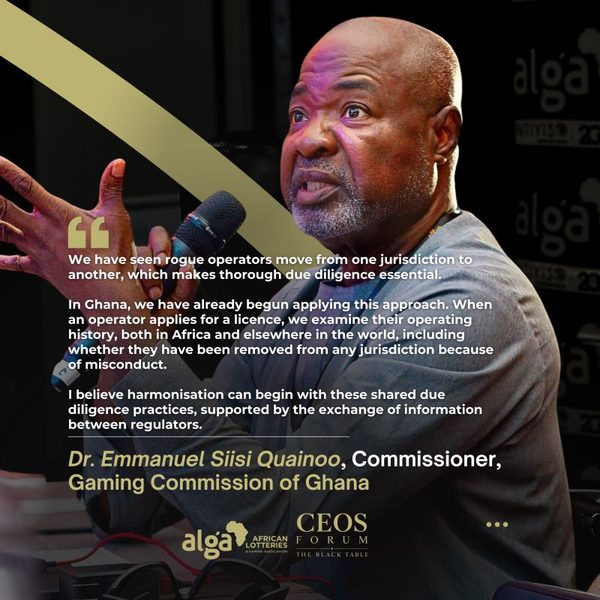
ALGA said operators’ regulatory histories should be examined beyond national borders, including previous licensing activities, compliance records and instances in which licences may have been revoked for misconduct.
Quainoo linked the approach to wider efforts to harmonise gambling regulation across African jurisdictions. “I believe harmonisation can begin with these shared due diligence practices, supported by the exchange of information between regulators,” he said.
ALGA said regulators needed to move beyond policy discussions towards practical cooperation, including sharing intelligence and establishing common standards. The association argued that these measures could strengthen accountability, protect consumers and uphold the integrity of regulated gaming and lottery markets.
Frequently asked questions (FAQs)
- What checks does Ghana’s Gaming Commission carry out on licence applicants? The Commission examines applicants’ operating histories in Africa and elsewhere in the world. This includes previous licensing activity, compliance records and whether an applicant has been removed from a jurisdiction because of misconduct.
- Why is Ghana applying cross-border due diligence to gaming operators? Acting Commissioner Emmanuel Siisi Quainoo said operators can move between jurisdictions and exploit gaps in regulatory oversight. He argued that thorough due diligence is therefore essential.
- How does Ghana’s approach relate to wider African regulatory harmonisation? Quainoo said harmonisation could begin with shared due diligence practices supported by information exchange between regulators. ALGA also called for practical cooperation, including intelligence sharing and common standards.